

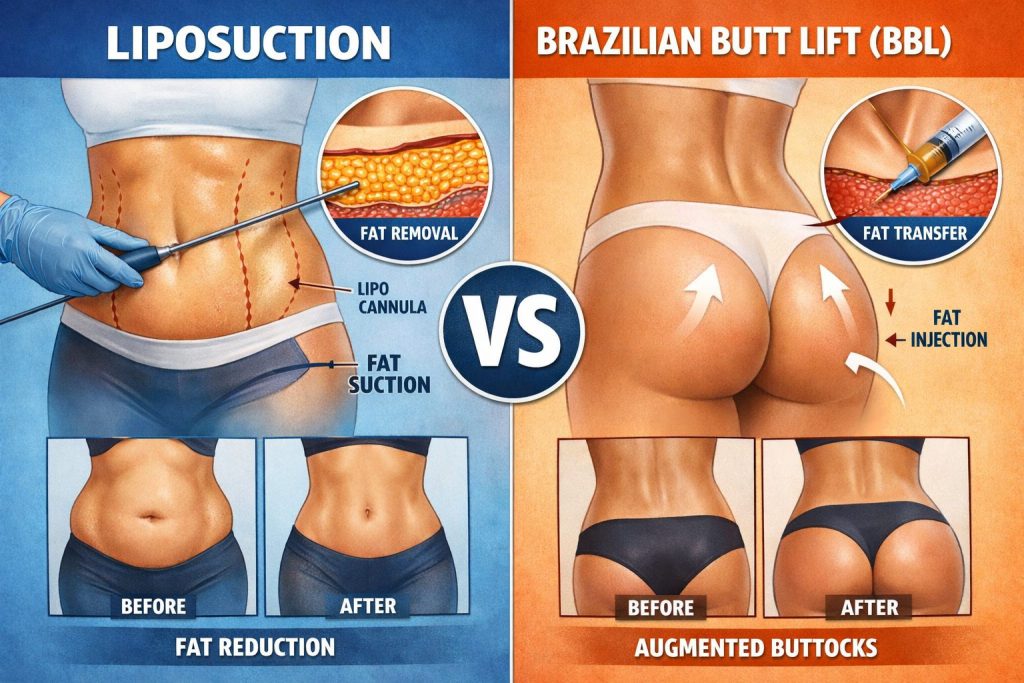
You’ve probably been thinking about body contouring for a while. You know which areas bother you. You’ve looked at before-and-after photos. You’ve imagined how clothes might finally sit differently on your body. Then the research begins, and you keep coming across terms like liposuction vs BBL.
While they’re often presented as if they are separate options, that framing can be misleading. Both procedures involve fat, but they are not opposing choices. A Brazilian Butt Lift (BBL) is built on liposuction; it uses fat that has already been removed. Liposuction forms the foundation, and in some cases, a portion of that fat may be safely redistributed to enhance shape.
For plus size patients, understanding this relationship matters even more.
How Liposuction and BBL Work Together in Body Contouring
Liposuction is designed to remove fat and improve body contours. When appropriate, a BBL builds on that same process by selectively reintroducing a portion of the removed fat to enhance projection and shape.
Dr. Masri explains this clearly during consultations:
- Liposuction is subtractive: It removes fat to improve proportion, reduce bulk, and smooth transitions.
- Fat transfer (BBL component) is redistributive: After removal, a portion of fat may be processed and carefully reintroduced in limited amounts to adjust shape.
In higher-BMI patients, the addition of fat transfer introduces a different risk profile compared to fat removal alone. For this reason, discussions about body contouring must be grounded in anatomy, achievable outcomes, and patient safety, not just desired shape.
How Liposuction and Fat Transfer (BBL Component) Fit Together
| Aspect | Liposuction (Base Procedure) | When Fat Transfer Is Added (BBL Component) |
|---|---|---|
| Role in treatment | Removes fat to improve contour and proportion | Uses a portion of removed fat to enhance shape when appropriate |
| Purpose | Reduction and refinement | Redistribution for shape enhancement |
| Surgical approach | Standalone procedure | Performed as an additional step after fat removal |
| Risk profile | Lower when performed conservatively | Increases due to added procedure time and technical demands |
| Recovery | Focus on compression and swelling control | Requires strict positioning and pressure avoidance |
| Suitability | Based on fat distribution and skin quality | Only considered if tissue support and goals may be achieved safely |
What “Plus Size” Actually Means in Plastic Surgery
In over two decades of evaluating body contouring candidates, Dr. Masri emphasizes that BMI alone rarely determines surgical safety.
“BMI tells me very little about how tissue behaves under tension.”
Instead, he evaluates fat depth and location (superficial vs. deep), skin elasticity and recoil, overall health, weight stability, and how tissue responds to manipulation during examination. Two patients with the same BMI can have completely different surgical options and risk profiles.
BMI is a screening tool, not a decision-maker.1
Liposuction for Plus Size Patients: Dr. Masri’s Perspective
Liposuction can be an effective contouring tool for plus size patients when it’s used for refinement, with reduction considered in appropriate cases.
“The complication rate rises sharply when liposuction is treated like weight loss.”
Large-volume fat removal increases the risk of fluid imbalance, irregular contours, prolonged swelling, and delayed healing.2
Common Areas Treated
Abdomen and waist, flanks, back and bra roll, arms, and thighs.
For most plus size patients, liposuction works best when the goal is proportion and balance, not dramatic size change.
When Fat Transfer May Be Considered
A plus size BBL is one of the most technically demanding procedures in body contouring and is only considered when it can be performed safely. While donor fat is often available in higher-BMI patients, Dr. Masri approaches fat transfer carefully.
The key consideration is not the amount of fat, but how safely it can be placed, how well it will survive, and whether the surrounding tissue can support it.
Higher BMI increases risk when large fat volumes are transferred, operative time becomes prolonged, and injection planes are not strictly controlled.3,4
Because of this, fat transfer is only incorporated when anatomy and tissue support allow it without increasing risk.
You can view examples of the plus size before-and-after gallery here.
When Liposuction Alone Is Recommended
Fat transfer is not always an appropriate addition. Learning the differences between liposuction vs BBL does not necessarily imply making a decision between the two, but rather figuring out what your body can successfully maintain. Liposuction alone has, in most cases, offered a more predictable and permanent result, depending on the patient’s anatomy and objectives.
Dr. Masri may recommend liposuction without fat transfer when adequate buttock volume already exists, the main concern is abdominal or back fullness, excess skin requires excision to improve contour, or the overall risk profile makes additional procedures less safe.2,3
How Treatment Goals Influence Surgical Planning
It is not a procedure selection process, but rather a process of matching the surgical plan with the patient’s anatomy and desired result. In the case of reduction and refinement, liposuction can be adequate on its own. In situations where the objective involves shape improvement, redistributing a small amount of fat can be an option provided that anatomy can support it.
How Risk Changes With Fat Removal and Fat Transfer
Liposuction carries its own set of risks, which can increase with excessive fat removal, prolonged operative time, and poor skin retraction.2
When fat transfer is added, the overall risk profile changes and becomes more complex, especially in higher-BMI patients. Risk increases further when transfer volumes are excessive, injection depth is not strictly controlled, and operative time is extended due to the added step.3,4
Because fat transfer builds on liposuction, it must be approached with additional caution and strict technique to maintain safety.
Why Staged Procedures Are Often Safer
Rather than combining aggressive liposuction with large-volume fat transfer, Dr. Masri often stages contouring.
“This gives tissue time to recover. Achieving the desired result often requires a second or even third procedure.”
Staging has been shown to reduce complications, improve predictability, and preserve fat graft survival.5
Recovery: What Plus Size Patients Should Expect
Dr. Nick Masri spends a significant portion of consultation time discussing recovery, because for plus size patients, recovery logistics often determine whether a procedure is tolerable — not just whether it is technically possible.
Recovery following liposuction alone is generally focused on swelling control and compression.2 Patients are typically able to move, sit, and reposition themselves more easily, which helps reduce strain during healing. Liposuction recovery typically involves consistent use of compression garments, managing swelling and fluid shifts, and gradual contour refinement over several weeks.
In cases where fat transfer is included, recovery is more limited and needs more planning, especially in patients with higher BMI. Since fat survival requires the absence of pressure, patients must adhere to rigorous positioning principles that influence sitting, sleeping, hygiene, and travel.5
Recovery with fat transfer may require avoiding direct pressure on the buttocks, use of specialized pillows and positioning techniques, longer and less predictable swelling periods, and close adherence to postoperative instructions to support fat survival.
Dr. Masri emphasizes that recovery capacity must match the surgical plan. If a patient’s body size, home support, or mobility makes these added recovery demands unrealistic, overall risk increases, even if the procedure itself is performed correctly.
Why Weight Stability Is Non-Negotiable
Dr. Masri considers weight stability one of the strongest predictors of success. Weight fluctuations after surgery can compromise fat graft survival and distort results, especially after BBL.6
This is particularly important for post–weight loss and GLP-1 patients.
Patient Testimonials and Case Experiences
Patients exploring body contouring often begin with a focus on adding volume or enhancing shape. However, during consultation, priorities frequently shift as they better understand how excess fat affects balance, mobility, and overall comfort, particularly in areas such as the abdomen, flanks, and back.
Dr. Nick Masri often works with patients who come to recognize that surgical planning based on proportion and long-term comfort leads to more satisfying outcomes. For many, liposuction alone provides meaningful improvement in mobility, clothing fit, and day-to-day comfort without introducing the added demands of further procedures.
Success is measured not only by shape, but by how the body feels during movement, sitting, and recovery. During consultation, Dr. Masri explains when fat removal alone is sufficient and when additional contouring steps, such as fat redistribution, may be considered — always based on anatomy and safety rather than expectations.
Real Reviews for Dr. Nick Masri and Body Contouring Decisions
“Dr. Masri is hands down the best surgeon in Miami. From my consultation to my aftercare, his bedside manner was exceptional. He took the time to explain why certain procedures were safer for me, and I never felt rushed or pushed. My safety was clearly his priority.”
“If I could give Dr. Masri 10 stars I would! After researching and following his practice for 3 years I finally decided I was ready for a life changing procedure. I could not be happier with my results, Dr Masri went above and beyond my expectations. Although everyone’s journey is different I can say for myself I would choose Dr Masri again and again. Both Angie and him have been heaven sent before, during, and, even after my procedure. 10/10 recommend!!”
These experiences reflect Dr. Masri’s consultation-first approach, where patient education, safety, and realistic outcomes guide every surgical decision.
The Bottom Line
The goal is not to choose between procedures — liposuction vs BBL — but to determine what the body can safely support. In many cases, fat removal alone achieves the most reliable and sustainable outcome. When appropriate, limited and carefully planned fat redistribution may be incorporated as part of the same surgical approach.
The right plan depends on anatomy, tissue behavior, overall health, and surgical judgment, not trends.1,3,4
Frequently Asked Questions
How is safety determined when considering liposuction with or without fat transfer?
Safety is based on patient anatomy, tissue quality, overall health, surgical technique, and operative time. Rather than viewing procedures as alternatives, planning focuses on whether fat transfer can be safely added to liposuction.2,3
What is the BMI limit for tummy tuck or BBL?
No standard Body Mass Index requirements exist to undergo tummy tuck or Brazilian Butt Lift surgery. BMI is taken as a screening method; however, surgeons focus more on general health, fat distribution, skin condition, and weight stability in assessing the safety of surgery.1
Would a BBL be acceptable following weight-loss surgery?
Brazilian Butt Lift surgery may be undertaken after weight-loss surgery once the weight has been stable for several months, since stable weight enhances the survival of the fat graft and minimizes postoperative complications.6
References (AMA Style)
- Jensen MD, Ryan DH, Apovian CM, et al. 2013 AHA/ACC/TOS guideline for the management of overweight and obesity in adults. Circulation. 2014;129(25 Suppl 2):S102–S138. doi:10.1161/01.cir.0000437739.71477.ee. https://pmc.ncbi.nlm.nih.gov/articles/PMC5819889/
- American Society of Plastic Surgeons. Liposuction safety. ASPS website. https://www.plasticsurgery.org/cosmetic-procedures/liposuction/safety
- Mofid MM, Teitelbaum S, Suissa D, et al. Report on mortality from gluteal fat grafting: recommendations from the ASERF Task Force. Plast Reconstr Surg. 2017;140(2):345–353. doi:10.1097/PRS.0000000000003562. https://pubmed.ncbi.nlm.nih.gov/28369293/
- American Society of Plastic Surgeons, The Plastic Surgery Foundation, The Aesthetic Society, and Aesthetic Surgery Education and Research Foundation. Gluteal fat grafting: a joint safety statement. ASPS website. https://www.plasticsurgery.org/for-medical-professionals/publications/psn-extra/news/gluteal-fat-grafting-a-joint-safety-statement
- Del Vecchio D, Kenkel JM. Practice Advisory on Gluteal Fat Grafting. Aesthetic Surgery Journal. 2022;42(9):1019–1029. doi:10.1093/asj/sjac082. https://pubmed.ncbi.nlm.nih.gov/35404456/
- DeMaria EJ, Pate V, Warthen M, Winegar DA. Baseline data from American Society for Metabolic and Bariatric Surgery–designated bariatric surgery centers of excellence using the bariatric outcomes longitudinal database. Surg Obes Relat Dis. 2010;6(4):347–355. doi:10.1016/j.soard.2009.11.015. https://pubmed.ncbi.nlm.nih.gov/20176512/