

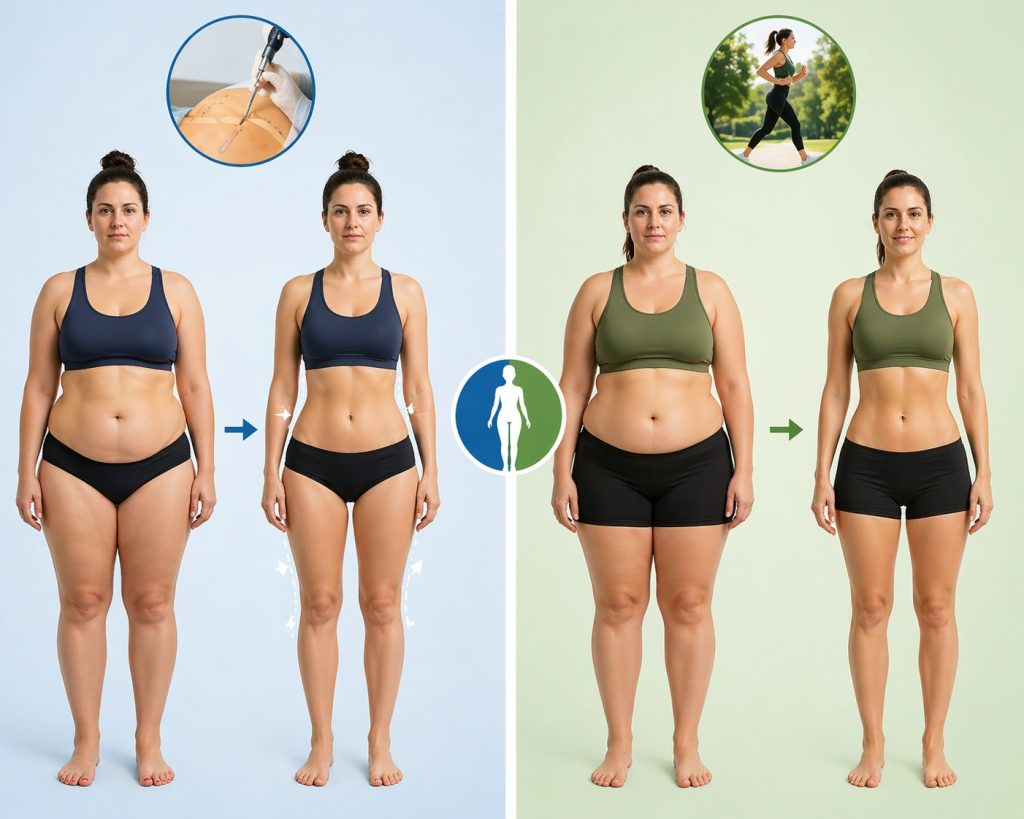
When patients come to see me for body contouring surgery, one of the most common questions they ask is: “Can liposuction replace weight loss?”
It is a very reasonable question, and it comes up in almost every consultation I have with patients who are trying to understand the difference between plus size liposuction and weight loss before deciding how to move forward safely.
And usually, the question is not just about appearance. It is about feeling physically lighter, reducing friction between the thighs, improving how clothing fits, and sometimes, avoiding a long and difficult weight-loss process.
So I address it very directly: “Liposuction changes shape. Weight loss changes health. They are not interchangeable.”
Once patients understand that, the entire conversation becomes clearer and more productive.
The Core Difference I Explain During Consultations About Plus Size Liposuction vs Weight Loss
When I explain plus size liposuction vs weight loss, I do not separate the body into isolated areas. I look at how the lower torso functions as a continuous structure.
Weight loss reduces fat globally, including visceral fat that affects metabolic health.2 Liposuction targets subcutaneous fat that disrupts proportion and creates a mechanical imbalance across connected regions, particularly the lower abdomen and groin junction, the flank and lateral thigh transition, and the inner thigh interface during movement.
These are not just cosmetic concerns. In higher-BMI patients, excess volume in these areas can create downward tissue pull, friction and irritation, and strain at structural junctions.
So surgical planning is not just about removing fat. It is about: “How will this area behave after volume is reduced, and how will it affect the skin connected to it?”
What Actually Happens During Plus Size Liposuction
Liposuction removes subcutaneous fat but does not remove visceral fat. Visceral fat surrounds the internal organs and is strongly associated with cardiovascular disease, diabetes risk, and metabolic syndrome.2
Patients often focus on how much fat can be removed. But that is not how I plan surgery. While safety guidelines support removing around four to five liters in a single procedure,1 I do not start with volume. I start with tissue behavior.
For example: Is the fat layer superficial and mobile, or dense and structurally resistant? Does removing volume reduce downward pull or create skin redundancy? Will the skin re-drape smoothly, or will it collapse unevenly?
In higher-BMI patients especially, aggressive fat removal can create irregular contour transitions, prolonged swelling due to large dissection zones, and redundant inelastic skin that may not contact and lay down smoothly.4
So my focus is: “What is the safe volume that improves proportion without destabilizing the surrounding tissue?” That is how we achieve results that look natural and heal predictably.
The “Groin Junction” and Lower Body Strain Pattern I Evaluate
One of the most important, but often overlooked, factors in higher-BMI patients is how lower-body tissue creates mechanical strain at the groin junction. When excess volume builds in the lower abdomen and upper thighs, it creates a downward vector of force that pulls on the groin crease, increases friction between the thighs, and alters how patients walk and sit.
In these cases, liposuction alone may reduce volume, but it may not fully correct the subsequent skin excess. This is where surgical judgment becomes critical. Sometimes I will limit liposuction volume to avoid worsening skin descent, or recommend combining it with skin excision.4
This is why I treat the lower body as a functional unit, not a collection of separate areas.
When Is Weight Loss the Right First Step?
Weight reduction produces important internal health improvements that surgery alone cannot reproduce. When patients lose weight in a structured and sustainable way, insulin sensitivity improves, cardiovascular workload decreases, respiratory function becomes more efficient, and inflammatory markers decline.3
Such physiological enhancements also make subsequent body contouring surgery safer and more predictable. In patients whose main aim is to improve their health rather than achieve a particular shape, I would tend to advise them to stabilize their weight before undergoing surgery.
When Liposuction Is Appropriate
In my practice, I recommend plus-size liposuction when I see a pattern of disproportion, not just excess weight. The best candidates are patients who have stable or stabilizing weight, show localized fat dominance (not evenly distributed), and have skin that can tolerate controlled volume reduction.1
But more importantly, they understand one thing: “This procedure is about refinement, not transformation.” Patients who come in with that mindset almost always have the best long-term outcomes.
What I Look For in a Strong Candidate When Evaluating Plus Size Liposuction and Weight Loss Options
When I evaluate patients comparing plus size liposuction vs weight loss, I am not just checking eligibility. I am determining whether the body can support the change we are about to create.
I look at weight stability — because fluctuating weight changes how fat is redistributed after surgery; fat distribution pattern — whether volume is localized or structurally widespread; skin behavior under tension — whether the skin will re-drape or collapse after fat removal; mechanical symptoms — such as thigh friction or lower abdominal pull; and expectation alignment — whether the patient understands this is refinement, not weight reduction.1
Two patients can look similar on the surface, but require completely different plans based on these factors. Patients who meet these criteria tend to have smoother contour transitions, more predictable healing, and results that remain stable over time.
When I Combine Procedures
In many higher-BMI patients, liposuction alone does not fully solve the problem. If I see lower abdominal overhang, lateral thigh descent, or loss of definition across the waist-to-hip transition, then I know the issue is not just fat — it is structural support and skin behavior.
In these cases, I plan surgery as a connected system, combining liposuction with extended abdominoplasty or lower body lift techniques. Because removing fat without addressing how the tissue is positioned can lead to incomplete or unstable results.4
The Role of Body Mass Index (BMI) in Surgical Planning
BMI gives me a general sense of surgical risk, but it does not guide my final decision. I have treated patients with similar BMI values who required completely different approaches. What I focus on instead is where the weight is concentrated, how the tissue behaves under stress, and whether the skin can tolerate repositioning.
Risk Factors Higher-BMI Patients Should Understand Before Liposuction
Anesthesia-Related Risk
In higher-BMI patients, anesthesia planning requires careful attention to airway anatomy, chest wall mechanics, and oxygen reserve.5 What I assess is not just BMI, but how easily the airway can be managed, how the patient tolerates lying flat for extended periods, and whether abdominal pressure affects breathing mechanics. These factors directly influence how safely the procedure can be performed and how long the surgery should last.
Venous Thromboembolism Risk
Higher BMI can increase the risk of blood clot formation after surgery. Larger treatment areas can increase operative time, and reduced mobility after surgery can slow circulation.6 So prevention is not just protocol; it is built into how I stage procedures, limit duration, and plan recovery support.
Infection Risk
Adipose tissue has a relatively lower blood supply, which can affect how efficiently the body delivers oxygen and immune support to healing areas.7 Clinically, I pay close attention to how thick the tissue layer is in the treated region, whether there are folds or areas of retained moisture, and how much surface area is being disrupted during the procedure. These factors influence whether I perform treatment in a single stage or divide it into safer, controlled steps.
Seroma Formation Risk
Fluid accumulation becomes more likely when larger areas of tissue are separated during surgery. In higher-BMI patients, this risk is influenced by the extent of the dissection plane, the mobility of the remaining tissue after fat removal, and how much dead space is created beneath the skin.4 So my approach is not just to remove fat, but to control how the tissue settles afterward, which directly reduces fluid-related complications.
Should You Lose Weight First or Consider Surgery Now?
This is one of the most crucial decisions we make jointly in consultation. When the main issue is metabolic health or the body’s overall weight load, then weight loss must precede.3 Liposuction can be suitable when the problem is localized disproportion that has remained despite a stable weight.1
In most situations, the right approach is to sequence them accordingly: first stabilize the body, then transform it in a predictable and orderly manner. Such a sequence leads to safer surgery and lasting results.
You can view examples of the plus-size before-and-after gallery here.
Real Patient Reviews: Liposuction & Body Contouring Experience
“Once I found out that Dr. Masri was my birthday twin, I knew that was a sign to get my procedure done by him. From start to finish he made me feel comfortable, he answered all of my questions, the recovery time was great, he made sure to always get back to me in a timely manner, and always greeted me with a smile. I would recommend him to anyone with no hesitation.”
Final Thoughts
Patients often compare plus size liposuction and weight loss as if they are competing options. They are not. They are two steps in the same process.
Weight loss improves internal health and reduces systemic risk.3 Liposuction refines external shape by correcting areas of disproportion that do not respond to weight reduction alone.1
The best outcomes happen when the sequence is respected: first stabilize the body, then correct the structural imbalance, then refine the contour in a controlled and safe way. That is how I achieve results that are not only visible, but balanced, sustainable, and appropriate for your body.
Frequently Asked Questions
What is the difference between plus size liposuction and weight loss?
Plus size liposuction decreases localized subcutaneous fat to enhance body shape and silhouette, whereas structured weight loss decreases total body fat including visceral fat stores that affect cardiovascular health, metabolic health, and insulin sensitivity.2
What is the safe amount of fat to remove in plus size liposuction?
The majority of conventional plastic surgery safety guidelines suggest up to four to five liters of fat removed in a single procedure session, which generally equates to about eight to eleven pounds, and is intended to improve proportion rather than achieve total weight loss.1
Does liposuction enhance metabolic well-being as weight loss does?
Liposuction enhances body proportionality by eliminating localized fat, but does not consistently lower visceral fat or produce the systemic metabolic effects of an organized weight-reduction program. It may help with insulin regulation in some patients, but it is not a substitute for medically structured weight management.2,3
References (AMA Style)
- American Society of Plastic Surgeons. Evidence-based patient safety advisory: liposuction. Plast Reconstr Surg. 2009;124(4)(suppl):28S–44S. https://pubmed.ncbi.nlm.nih.gov/20827238/
- Neeland IJ, Ross R, Després JP, et al. Visceral and ectopic fat, atherosclerosis, and cardiometabolic disease: a position statement. Nat Rev Endocrinol. 2019;15(7):393–406. https://pubmed.ncbi.nlm.nih.gov/31301983/
- Hall KD, Heymsfield SB, Kemnitz JW, Klein S, Schoeller DA, Speakman JR. Energy balance and its components: implications for body weight regulation. Am J Clin Nutr. 2012;95(4):989–994. https://pmc.ncbi.nlm.nih.gov/articles/PMC3302369/
- Swanson E. Prospective study of liposuction outcomes in 360 patients. Plast Reconstr Surg. 2012;129(4):965–971. https://pubmed.ncbi.nlm.nih.gov/22183499/
- Ogunnaike BO, Jones SB, Jones DB, Provost D, Whitten CW. Anesthetic considerations for bariatric surgery. Anesth Analg. 2002;95(6):1793–1805. https://pubmed.ncbi.nlm.nih.gov/12456461/
- Winocour J, Gupta V, Ramirez JR, Shack RB, Grotting JC, Higdon KK. Complications in body contouring surgery: an analysis of 4495 patients. Plast Reconstr Surg. 2015;136(5):597e–606e. https://pubmed.ncbi.nlm.nih.gov/26418767/
- Pierpont YN, Dinh TP, Salas RE, et al. Obesity and surgical wound healing: a current review. Adv Wound Care (New Rochelle). 2014;3(7):452–460. https://pubmed.ncbi.nlm.nih.gov/24761333/