

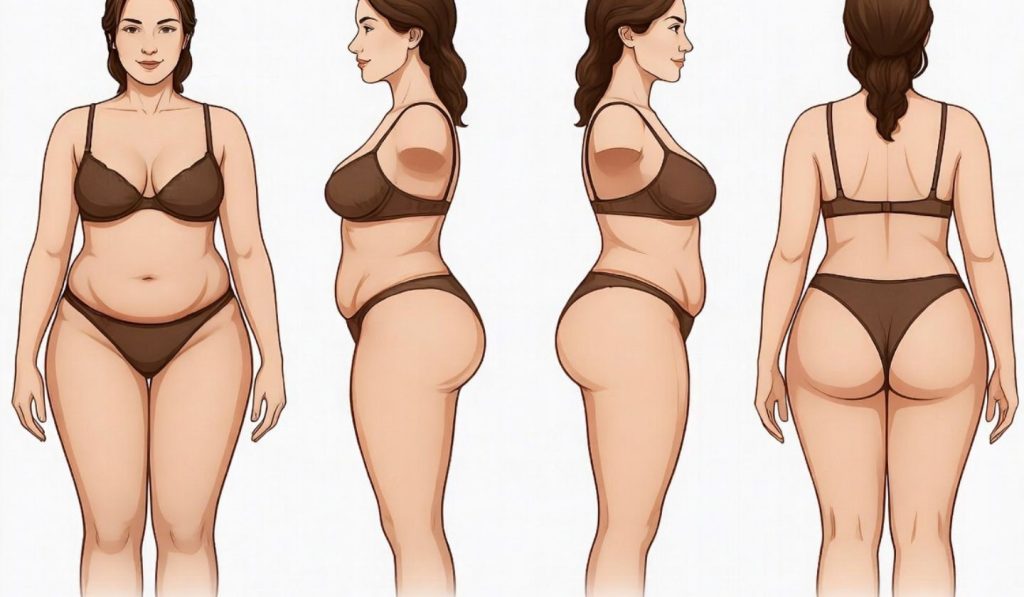
Dr. Nick Masri helps plus-size patients understand how liposuction is planned and, when appropriate, how fat transfer may be incorporated, based on fat behavior, skin quality, circulation, and closure stress, not BMI alone. His surgical planning for liposuction with BBL is based on hospital safety, low-fat transfer, and long-term tissue support instead of short-term volume gains.
You’ve probably been thinking about body contouring for a while. You know which areas bother you. You’ve looked at before-and-after photos. You’ve imagined how clothes might finally sit differently on your body. Then the research begins, and two procedures keep coming up: liposuction with BBL.
They’re often mentioned together because both involve fat. But in Dr. Masri’s words, they solve completely different problems. Choosing the wrong procedure for your anatomy can lead to unnecessary risk, limited improvement, or results that don’t hold up over time.
For plus size patients, the distinction matters even more.
The Core Difference Between Plus Size BBL with Liposuction and Liposuction Alone
Liposuction alone is designed to reduce fat and improve body contours, whereas a plus-size BBL with liposuction involves selective fat removal and limited fat transfer planned around tissue quality, circulation, and long-term structural support, not aesthetic volume alone.
Dr. Masri explains this distinction clearly during consultations:
- Liposuction is subtractive. It removes fat to improve proportion, reduce bulk, and smooth transitions.
- A Brazilian Butt Lift is redistributive. Fat is removed, processed, and strategically reintroduced to change projection and shape.
In higher-BMI patients, Dr. Masri notes, redistribution introduces a completely different risk profile than removal alone. That difference affects safety, healing, operative time, and long-term predictability.
This distinction is why discussions about liposuction with BBL must be grounded in anatomy, achievable results, and patient safety, not just the desired shape.
What “Plus Size” Actually Means in Plastic Surgery
In over two decades of evaluating body contouring candidates, Dr. Masri emphasizes that BMI alone rarely determines surgical safety.
“BMI tells me very little about how tissue behaves under tension.”
Instead, he evaluates fat depth and location (superficial vs. deep), skin elasticity and recoil, circulatory health, weight stability, and how tissue responds to manipulation during examination. Two patients with the same BMI can have completely different surgical options and risk profiles.
BMI is a screening tool, not a decision-maker.1
Liposuction for Plus Size Patients: Dr. Masri’s Perspective
Liposuction can be an effective contouring tool for plus size patients when it is used for refinement, with reduction considered in appropriate cases.
“The complication rate rises sharply when liposuction is treated like weight loss.”
Large-volume fat removal increases the risk of fluid imbalance, irregular contours, prolonged swelling, and delayed healing.2
Common Areas Treated
Abdomen and waist, flanks, back and bra roll, arms, and thighs.
For most plus size patients, liposuction works best when the goal is proportion and balance, not dramatic size change.
The Reality of Plus Size BBL
A plus size BBL is one of the most technically demanding procedures in body contouring. While donor fat is usually available, Dr. Masri approaches fat transfer conservatively in higher-BMI patients.
“The biggest issue isn’t lack of fat. It’s how safely that fat can be placed, and how well it survives.”
Higher BMI increases risk when large fat volumes are transferred, operative time becomes prolonged, and injection planes are not strictly controlled.3,4
The most serious complication, fat embolism, has been directly linked to improper injection depth.3 For this reason, Dr. Masri follows strict hospital-based protocols and conservative transfer limits.
When carefully selected, a plus size BBL may improve hip-to-waist ratio, enhance buttock projection, and create smoother transitions. But candidacy must be determined conservatively.
View examples in the plus size before-and-after gallery here.
Why Dr. Masri Often Recommends Liposuction Alone
Not every plus size patient benefits from fat transfer. In Dr. Masri’s practice, liposuction alone may offer a more predictable and sustainable outcome for certain individuals.
In consultations, Dr. Masri often sees patients with ample donor fat but poor deep-tissue support, which is why he frequently redirects them away from BBL despite expectations.
He may recommend liposuction alone when adequate buttock volume already exists, the main concern is abdominal or back fullness, skin quality limits fat graft survival, or BMI or circulation increases the procedural risk.2,3,4
A BBL cannot be performed without liposuction, as fat must first be harvested. However, it remains a distinct operation with different technical considerations and liabilities.
Shape Goals Matter More Than BMI
This decision is about structure, not numbers. Understanding whether the goal is reduction or redistribution helps prevent mismatched expectations and unsafe surgical plans.
Patients seeking reduction and refinement often benefit most from liposuction. Patients seeking projection and curvature may consider BBL, if anatomy allows. Confusing these goals is one of the most common reasons for postoperative dissatisfaction.
Safety Considerations Dr. Masri Prioritizes
Liposuction risk increases with excessive fat removal, prolonged operative time, and poor skin retraction.2
BBL risk increases with higher BMI, larger transfer volumes, and improper injection depth.3,4
This is why Dr. Masri frequently discusses staged procedures.
Why Staged Procedures Are Often Safer
Rather than combining aggressive liposuction with large-volume fat transfer, Dr. Masri often stages contouring.
“This gives tissue time to recover, and allows us to reassess shape safely.”
Staging has been shown to reduce complications, improve predictability, and preserve fat graft survival.5
Recovery: What Plus Size Patients Should Expect
Dr. Nick Masri spends a significant portion of consultation time discussing recovery, because for plus size patients, recovery logistics often determine whether a procedure is tolerable, not just whether it is technically possible.
With liposuction, recovery is usually about swelling control and compression.2 Patients can move, sit, and reposition themselves more easily, which reduces strain during healing. Recovery typically focuses on consistent use of compression garments, managing swelling and fluid shifts, and gradual contour refinement over several weeks.
BBL recovery introduces a different set of challenges. For higher-BMI patients, sitting restrictions are not a small inconvenience — they affect sleep, hygiene, transportation, and the ability to safely care for incisions. BBL recovery often requires strict avoidance of direct sitting on the buttocks, specialized pillows and positioning at all times, longer and more unpredictable swelling periods, and close adherence to postoperative instructions to protect fat survival.5
Dr. Masri often emphasizes that recovery capacity must match the procedure. If a patient’s body size, home support, or mobility makes BBL recovery unrealistic, the surgical risk increases, even if the operation itself goes well.
Why Weight Stability Is Non-Negotiable
Dr. Masri considers weight stability one of the strongest predictors of success. Weight fluctuations after surgery can compromise fat graft survival and distort results, especially after BBL.6
This is particularly important for post–weight loss and GLP-1 patients.
Patient Testimonials and Case Experiences
Patients who choose between liposuction and BBL usually report experiencing a change in priorities when consulting. Most people want added volume, although they find that they become preoccupied with heaviness, imbalance, or discomfort that excess fat may cause in the abdomen, flanks, or back.
Dr. Nick Masri is often involved with patients who find that planning surgery on the basis of proportion and long-term comfort is much more likely to produce relief than disappointment. To a great number, liposuction is the sole way to feel more mobile, comfortable in clothes, and at ease in everyday life without posing a risk of more procedures.
Success is measured not only by shape, but by how the body feels during movement, sitting, and recovery. A consultation allows Dr. Masri to explain these trade-offs clearly, helping patients understand which option aligns with their anatomy rather than expectations.
Real Reviews for Dr. Nick Masri and Body Contouring Decisions
“Dr. Masri is hands down the best surgeon in Miami. From my consultation to my aftercare, his bedside manner was exceptional. He took the time to explain why certain procedures were safer for me, and I never felt rushed or pushed. My safety was clearly his priority.”
“What stood out most was Dr. Masri’s honesty. He explained what would and wouldn’t work for my body instead of promising everything. The results feel natural, and recovery went exactly as he described. I felt informed and protected the entire time.”
The Bottom Line
Ultimately, the decision between liposuction alone or combining liposuction with a BBL is not about choosing more or less surgery, but about selecting the approach the body can safely support. They serve different purposes. The right choice depends on anatomy, tissue behavior, health, and surgical judgment, not trends.
“When safety, realism, and long-term tissue behavior guide the plan, results tend to hold.”
Frequently Asked Questions
What is the BMI limit for tummy tuck or BBL?
No standard Body Mass Index requirements exist for tummy tuck or Brazilian Butt Lift surgery. BMI is taken as a screening method; however, surgeons focus more on general health, fat distribution, skin condition, circulation, and weight stability when assessing the safety of surgery.1
Is it safer to use liposuction rather than BBL in plus size patients?
When evaluating procedures such as liposuction or a Brazilian Butt Lift, the most important consideration is the individual patient. Safety is determined by proper patient selection, surgical technique, operative time, and surgeon experience. A comprehensive consultation ensures the chosen approach aligns with the patient’s anatomy and desired outcome.2,3,4
Would a BBL be acceptable following weight-loss surgery?
Brazilian Butt Lift surgery may be undertaken after weight-loss surgery once the weight has been stable for several months, as stable weight enhances fat graft survival and minimizes postoperative complications.6
References
- Jensen MD, Ryan DH, Apovian CM, et al. 2013 AHA/ACC/TOS guideline for the management of overweight and obesity in adults. Circulation. 2014;129(25 Suppl 2):S102–S138. doi:10.1161/01.cir.0000437739.71477.ee. https://pubmed.ncbi.nlm.nih.gov/24222017/
- American Society of Plastic Surgeons. Liposuction safety. ASPS website. https://www.plasticsurgery.org/cosmetic-procedures/liposuction/safety; See also: https://pmc.ncbi.nlm.nih.gov/articles/PMC5819889/
- Mofid MM, Teitelbaum S, Suissa D, et al. Report on mortality from gluteal fat grafting: recommendations from the ASERF Task Force. Plast Reconstr Surg. 2017;140(2):345–353. doi:10.1097/PRS.0000000000003562. https://pubmed.ncbi.nlm.nih.gov/28369293/
- American Society of Plastic Surgeons, The Plastic Surgery Foundation, The Aesthetic Society, and Aesthetic Surgery Education and Research Foundation. Gluteal fat grafting: a joint safety statement. ASPS website. https://www.plasticsurgery.org/for-medical-professionals/publications/psn-extra/news/gluteal-fat-grafting-a-joint-safety-statement
- Del Vecchio D, Kenkel JM. Practice Advisory on Gluteal Fat Grafting. Aesthetic Surgery Journal. 2022;42(9):1019–1029. doi:10.1093/asj/sjac082. https://pubmed.ncbi.nlm.nih.gov/35404456/
- DeMaria EJ, Pate V, Warthen M, Winegar DA. Baseline data from American Society for Metabolic and Bariatric Surgery–designated bariatric surgery centers of excellence using the bariatric outcomes longitudinal database. Surg Obes Relat Dis. 2010;6(4):347–355. doi:10.1016/j.soard.2009.11.015. https://pubmed.ncbi.nlm.nih.gov/20176512/