

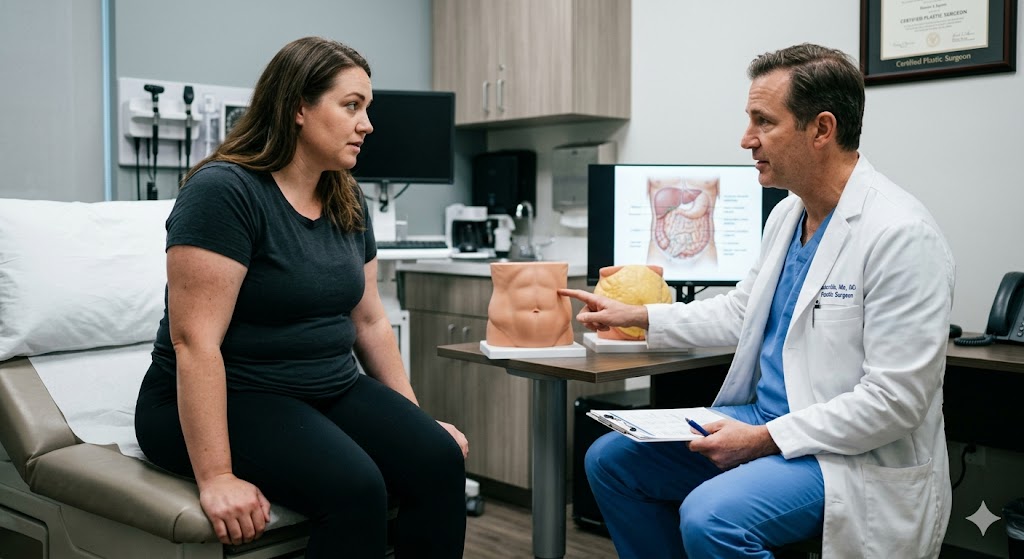
Most patients asking about surgery at a higher BMI are really trying to understand the risks of tummy tuck and whether those risks apply to their specific body and health profile. They ask: “Is this safe for me, or am I at risk of something going wrong?”
The answer is not based on a number alone. Safe candidacy depends on how your tissue behaves under surgical stress, not BMI by itself. Large outcome studies do show that patients with BMI ≥30 experience higher complication rates after abdominoplasty, particularly when it comes to wound healing and thromboembolism.1
But what matters more in real surgical planning is not just that risk exists, but whether your body can tolerate and recover from the specific demands of the operation.
Before I proceed with surgery, I evaluate several key factors that determine whether healing will be reliable. When the conditions are met, many patients with elevated BMI can still move forward safely.
The difference is that the operation is not approached in a standard way; it is modified deliberately to protect the blood supply, reduce tension, and support predictable healing.
How BMI Affects Patients Considering a Tummy Tuck at Higher Body Weight
One of the biggest misconceptions I correct early is this: “This is not just an abdominal procedure. At higher BMI, the lower abdomen, flanks, and groin junction behave as one mechanical unit.”
That means when I plan surgery, I’m not just thinking about what to remove. I’m thinking about how forces redistribute across that entire lower-body system after closure.
When patients first start researching surgery, they usually encounter the phrase BMI limit for tummy tuck eligibility and assume it’s a strict cutoff.
It isn’t.
But what I explain during the consultation is this:
“BMI doesn’t decide if you can have surgery. It tells me how your tissue is going to behave once I operate.”
At higher BMI, risks increase in predictable, mechanical ways, and those changes directly affect:
- How aggressively can I operate
- How do I design the incision
- How much tension can the closure bear
- Whether the result will heal and hold over time
Body Mass Index is not simply a number on a chart. It directly influences flap blood supply, closure strength, anesthesia tolerance, clot risk, scar quality, and long-term contour stability.
The risks of tummy tuck increase at higher BMI, not because of a single factor, but because of how tissue perfusion, closure tension, and healing capacity interact during and after surgery.
In my own practice, after performing thousands of abdominal contouring procedures over more than two decades, I’ve seen that complication patterns don’t happen randomly; they follow tissue behavior once BMI rises.
Large multicenter outcome research analyzing 25,478 abdominoplasty procedures confirmed that BMI ≥30 is an independent predictor of complications.1
That’s why evaluating tummy tuck risks at high BMI is about predictability, not restriction.
Blood Supply Is the First Surgical Limiting Factor I Evaluate
The area I watch most closely is the central lower abdominal flap, where thickness is greatest, and perfusion is most easily compromised. This is where I see the earliest signs of vascular stress during surgery. If this zone does not look healthy, I adjust immediately.
Every abdominoplasty depends on circulation through the abdominal flap after elevation. When I lift the skin and fat from the abdominal wall, that tissue immediately becomes dependent on remaining perforating vessels for survival.
At higher BMI:
- Adipose tissue contains fewer capillaries
- Flap thickness increases oxygen demand
- Perfusion reliability decreases1
What most patients don’t see is this decision happening in real time:
“How far can I safely elevate this flap before I compromise its survival?”
If perfusion becomes questionable, I stop. Because at that point, the complication is no longer theoretical — it is decided intraoperatively, based on how your tissue responds.
Closure Tension Changes the Entire Healing Environment
The highest tension is not evenly distributed. It concentrates on the lower abdominal incision and extends toward the groin junction, where downward force and lateral pull meet. This is the exact location where most wound healing problems begin if tension is underestimated.2
Among all the risks of tummy tuck, complications like delayed healing and thromboembolism are the ones that require the most careful surgical planning and prevention.
After tissue removal, the operation is no longer about shaping. It becomes about whether the closure will hold under stress.
Higher BMI increases:
- Intra-abdominal pressure
- Downward gravitational pull across the lower abdomen
- Strain at the lower incision line and groin junction
That groin junction area is where I most often see problems when tension is underestimated.
When closure tension becomes excessive, predictable complications follow:
- Wound separation
- Delayed healing
- Widened or unstable scars2
So I often make a decision patients don’t expect: I removed less tissue than planned to protect the closure. Patients come in wanting maximum removal. My priority is a closure that survives, heals, and stays stable long-term.
This is also where surgical judgment matters most. Over-resection at high BMI doesn’t fail in the operating room; it fails during healing.
Seroma Formation Is a Mechanical Risk That Increases With BMI
Seromas are fluid collections beneath the abdominal flap. In higher BMI patients, they are not random; they are mechanically driven.
They occur more frequently because:
- The flap surface area is larger
- Lymphatic disruption is greater
- Dead space volume increases1
To reduce this risk, I modify the technique by limiting unnecessary dissection and controlling flap movement during closure.
Even with these adjustments, seroma remains one of the most common complications after abdominoplasty in higher-BMI patients. That’s not a failure of surgery. It’s a reflection of how tissue behaves after surgical manipulation which creates inflammation.
Infection Risk Increases When Tissue Oxygenation Drops
Infection is not random after a tummy tuck. It happens when the healing environment becomes compromised. At higher BMI, I frequently see reduced oxygen delivery to tissue, longer operative times, and moisture retention in lower abdominal folds. This combination creates conditions where bacteria can grow more easily.
Large surgical outcome studies show 27.2% of major abdominoplasty complications are infections.1
That’s why, in higher BMI surgery, I am not just performing a contour procedure. I am actively managing a biological environment that is more prone to breakdown.
Anesthesia Safety Changes at Higher BMI
Most patients focus on results. But intraoperatively, my concern shifts to physiology and safety margins.
Higher BMI affects:
- Airway positioning
- Diaphragm excursion
- Lung expansion
- Oxygen reserve
When I see those risks increasing, I change the plan. Sometimes that means:
“This should not be done in a surgery center. This belongs in a hospital setting.”
That decision is not about preference. It’s about control, monitoring, and safety capacity if something changes mid-procedure.
Blood Clots Are the Risk I Respect the Most
Among all tummy tuck risks at high BMI, thromboembolism is the one I take most seriously. Abdominoplasty already carries one of the highest risks of clots among cosmetic procedures.4 When BMI increases, that risk increases further.3 So my approach is not optional; it is protocol-driven.
I build prevention into every case:
- Intraoperative compression devices
- Early post-operative mobilization
- Selective anticoagulation
- Strict control of operative time
These are not add-ons. They are part of the operation itself.
Muscle Repair Does Not Always Behave the Same Way at Higher BMI
Muscle tightening is often expected. But I don’t automatically perform it. Because the real question is:
“Will this repair hold under your internal pressure long-term?”
Higher BMI increases strain across the repair.2 If I believe it will stretch or fail, I modify or avoid it. After more than 20 years in surgery, I’ve learned:
A repair that looks good on day one but fails later is not a success.
Durability always comes first for me.
The Aesthetic Result Itself Can Be Limited at Higher BMI
Even when surgery is safe, results are different. Higher BMI often produces:
- Thicker residual abdominal flaps
- Softer contour definition
- Slower skin contraction
So I explain this clearly during the consultation: the goal is not the flattest abdomen possible. The goal is the safest improvement your anatomy can support.
How I Determine Whether Someone Meets BMI Requirements for a Tummy Tuck
BMI is only one variable. What I actually evaluate is:
- Fat distribution pattern
- Skin elasticity and recoil
- Tissue thickness under tension
- Smoking status
- Metabolic health
- Cardiopulmonary reserve
- Weight stability timeline1
Two patients with the same BMI can have completely different surgical risks. That’s why I never apply a rigid cutoff.
When I Recommend Waiting Before Surgery
Sometimes the safest decision is to wait. Even modest weight reduction improves flap perfusion, closure reliability, anesthesia tolerance, scar quality, and overall complication rates.3
So when I advise waiting, I explain it this way:
We’re not delaying surgery.
We’re improving the conditions so your result actually holds.
I evaluate tummy tuck candidates with elevated BMI using safety protocols aligned with national plastic surgery standards and treat body contouring patients across the United States.
You can view examples of the plus-size before-and-after gallery here.
Real Reviews for Dr. Nick Masri and Tummy Tuck Surgery
Please see the patient experiences below from RealSelf from individuals who underwent abdominal contouring procedures such as tummy tuck surgery:
“Dr. Masri is hands down the best surgeon in Miami. From my consultation to my aftercare, his bedside manner was exceptional. He made me feel completely confident in his approach and took the time to explain every detail of the procedure. My recovery was smooth, and the results look natural and balanced. Safety was clearly his top priority throughout the entire process.”
“Dr. Masri and his staff are amazing caring and always there to support you throughout your process. I am 7 months post-op and he has been there for me every step of the way. I had an abdominoplasty and 7 months later you can barely see the scar. The pre during and post care is very comforting. I can not thank him enough for his work and support. Truly God sent.”
“I love the way he treated me like family. He really takes care of you after surgery.”
“Dr. Nick Masri and his staff are absolutely the best! From the minute you step into his office you will feel comfortable and at ease. Dr. Masri is one of the best plastic surgeons in the country. He takes the utmost pride in his work. My breast augmentation and eye lift both look completely natural. You will be nothing but pleased with his work. I highly recommend Dr. Masri for any PS needs!”
The Bottom Line
A tummy tuck at a high BMI is not automatically unsafe. But it is not the same operation.
Higher BMI changes:
- Tissue perfusion
- Incision tension
- Anesthesia safety
- Clot risk
- Healing predictability
- Long-term stability
When I evaluate patients, I’m not asking: “Can this be done?” I’m asking: “Will this heal properly and last?”
Sometimes the answer is to proceed carefully. Sometimes the answer is to prepare first. Both are part of responsible surgical planning. The difference is not just risk level. It’s how the body responds to surgery as a system, before, during, and after the operation.
Understanding the risks of tummy tuck at a higher BMI is not about discouraging surgery, but about making informed decisions based on how your body will respond and heal.1,3,4
Frequently Asked Questions
What BMI is at high risk of tummy tuck?
BMI 30 or higher is viewed by most surgeons as a higher-risk group since the rate of complications rises in a statistically significant way beyond this point.1 Candidacy, however, is based on tissue perfusion, medical optimization, and maintenance of weight as opposed to BMI.
Is it safe to have a tummy tuck with a BMI of greater than 30?
Most patients over BMI 30 can safely proceed when they are medically optimized, nicotine-free, weight-stable, and operated on using modified surgical procedures designed to lessen the tension of the closure and guard against blood supply issues.2
Is the risk after abdominoplasty increased by higher BMI?
Yes. Abdominoplasty is already potentially associated with quantifiable thromboembolism, and the risk of clots rises with BMI past 30; thus, the routine use of compression with anticoagulation protocols and early mobilization by surgeons, where necessary.3,4
Would the results be different if BMI is higher at the time of surgery?
The end result achieved at higher BMI tends to be less abdominal definition and thicker residual tissue than that found at lower BMI, though it remains possible to achieve contour improvement of significance.1
References (AMA Style)
- Winocour J, Gupta V, Ramirez JR, Shack RB, Grotting JC, Higdon KK. Abdominoplasty: risk factors, complication rates, and safety of combined procedures. Plast Reconstr Surg. 2015;136(5):597e–606e. https://doi.org/10.1097/PRS.0000000000001719
- Somogyi RB, Ahmad J, Shih JG, Lista F. Venous thromboembolism in abdominoplasty: a comprehensive approach to lower procedural risk. Aesthet Surg J. 2012;32(3):322–329. https://academic.oup.com/asj/article/32/3/322/261369
- Hatef DA, Kenkel JM, Nguyen MQ, et al. Thromboembolism in plastic surgery. Plast Reconstr Surg. 2008;122(1):1–9. https://doi.org/10.1097/PRS.0b013e3181774386
- Keyes GR, Singer R, Iverson RE, Nahai F. Incidence and predictors of venous thromboembolism in abdominoplasty. Aesthet Surg J. 2018;38(2):162–173. doi:10.1093/asj/sjx147. https://doi.org/10.1093/asj/sjx147