

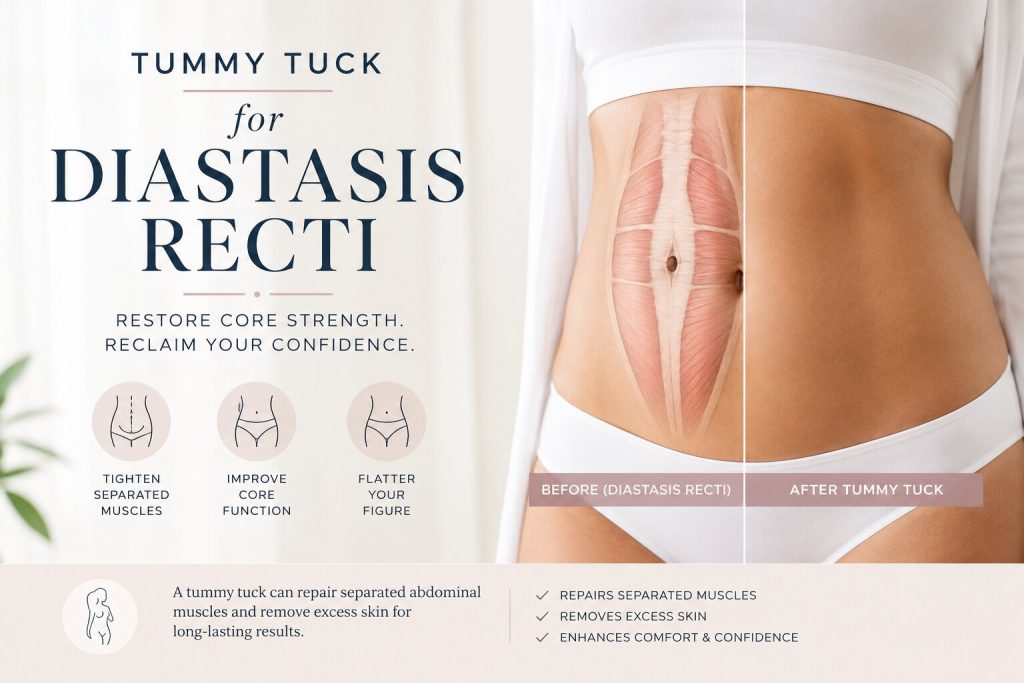
A tummy tuck for diastasis recti becomes necessary when the connective tissue between the abdominal muscles has stretched beyond its ability to recoil naturally. Patients come into my office every week, frustrated by the same problem. They lost weight. They returned to the gym. They committed to healthier habits. Some spent years doing postpartum rehabilitation, Pilates, core strengthening, and abdominal training. Yet the stomach still projects outward.
The lower abdomen feels weak. Clothing fits differently. The waistline disappears from certain angles. Some patients tell me they still look several months pregnant despite doing “everything right.” Others notice the abdomen becomes more prominent later in the day because the weakened abdominal wall can no longer contain pressure efficiently.
Many people assume this is stubborn fat. In reality, what I often find is structural abdominal wall failure. I explain to patients all the time that some abdominal problems stop being fitness problems and become anatomical problems.
That is why my surgical evaluation is never limited to skin alone. I evaluate the direction of abdominal wall tension, how the skin drapes across the lower abdomen, whether pressure is concentrated centrally or toward the groin junction, the quality of the fascia holding the abdominal wall together, and whether the protrusion is caused by muscle separation, internal fat, skin laxity, or all three simultaneously.
That level of planning changes the operation completely.
What Is Diastasis Recti?
Diastasis recti occurs when the rectus abdominis muscles separate along the midline of the abdomen. The connective tissue between the muscles, called the linea alba, stretches and weakens over time.2
Pregnancy is the most common cause I see in my practice. Massive weight fluctuations and abdominal pressure can create similar changes as well. However, many patients misunderstand what they are actually seeing in the mirror.
The issue is not always excess fat. Sometimes the abdominal wall itself has lost the ability to function as a stable internal corset. In some patients, the weakness is most obvious above the belly button. In others, the tension failure extends lower toward the mons pubis and groin junction, where the tissue experiences constant downward pull from the lower abdomen.
That anatomical nuance matters because not all abdominal separation behaves the same way surgically.
Why Exercise Alone Does Not Always Correct Diastasis Recti
Patients often tell me they feel defeated. They spent months doing planks, crunches, Pilates, and physical therapy, yet the abdominal projection remains. This happens because exercise cannot always reverse structural connective tissue stretching.
Research shows physical therapy may improve symptoms in mild cases, but severe separation often persists once the connective tissue permanently widens.1
One of the most important decisions I make during consultation is determining whether the patient has functional weakness that may still improve conservatively, or permanent structural separation requiring surgical repair.
Some patients primarily carry visceral fat internally around the organs. Others have bloating, hormonal abdominal distention, or generalized obesity without major muscle separation. A tummy tuck is not designed to treat every type of abdominal fullness. This is why physical examination matters far more than online self-diagnosis. The skin, fascia, muscle, fat distribution, and internal abdominal volume all behave differently.
BMI and Weight Stability Before Tummy Tuck for Diastasis Recti
One of the most important topics I discuss during consultation is weight stability. A tummy tuck for diastasis recti is not a weight-loss procedure. It is a structural reconstruction and contouring procedure designed for patients who are relatively close to a stable, maintainable weight.
BMI screening is recommended because a higher BMI can be a risk factor for wound healing issues, fluid collections, infection, anesthesia complications, and blood clots after body contouring surgery.4
However, I do not make decisions based on BMI alone. I look at where the weight is distributed, whether the fat sits superficially or internally, tissue thickness, skin quality, mobility and cardiovascular health, smoking history, previous abdominal surgery, and the predicted healing capacity.
This is one reason I perform higher-BMI body contouring procedures in accredited hospital settings. Patients with a BMI limit for tummy tuck sometimes require more advanced monitoring, longer recovery observation, and stricter postoperative safety protocols than smaller outpatient facilities can comfortably provide.
The “why” behind the hospital setting is safety, not marketing. I also tell patients something very important: if the weight continues changing significantly after surgery, the repair itself can stretch again over time. Long-term stability matters just as much as the operation itself.
Why a Tummy Tuck Improves Function, Not Just Appearance
When the abdominal wall is reconstructed properly, many patients notice improvements in posture, stability, and how the core engages during movement.2
Patients commonly report better core engagement, improved posture awareness, less lower abdominal heaviness, reduced abdominal bulging after meals or standing, improved clothing fit, greater comfort during activity, and improved body confidence after pregnancy or weight loss.
A tummy tuck for diastasis recti is not a shortcut around healthy habits. Surgery creates structural support. Long-term outcomes still depend on nutrition, weight stability, exercise, and lifestyle choices.
How I Repair Diastasis Recti During a Tummy Tuck
A tummy tuck with muscle repair directly addresses the structural weakness underneath the skin. In surgery, I open up the abdomen and evaluate the characteristics of the abdominal wall under tension. I then pull the rectus muscles back together toward the midline and strengthen the stretched-out connective tissue with internal sutures.2
But the operation is not simply about “pulling tighter.” One of the biggest mistakes in abdominal contouring is over-tightening the repair. Patients often assume tighter automatically means better. Surgically, that is not true. Too much force may result in over-tightening, which puts strain on the tissues, disrupts circulation, makes it painful, and may cause breathing issues which are usually temporary.
I want the abdomen to look natural, supported, and proportionate rather than compressed. Depending on the patient’s anatomy, surgery may also include:
- Removal of excess abdominal skin
- Liposuction along the flanks for waist refinement
- Mons pubis contour adjustment when tissue descent affects the lower abdomen
- Belly button repositioning for natural proportions
- Incision planning designed around clothing preferences whenever anatomically safe
Some patients specifically ask about lower scar placement for modern swimwear. If a scar is lowered too aggressively, it may cause tension, affect scar healing, or alter the final contour. This is why incision planning always has to take aesthetics and tissue safety into consideration.
Common Risks Patients Should Understand Before Surgery
The possible risks include bleeding, infection, delayed wound healing, fluid accumulation (seroma), blood clots, pulmonary complications, changes in sensation, scarring (including keloid, hypertrophic, or aesthetically displeasing scars), asymmetry, and recurrent abdominal laxity over time.
Venous thromboembolism remains one of the most important safety considerations in body contouring surgery, particularly in longer operations or patients with elevated BMI risk factors.3
That is why my planning includes careful patient selection, limiting unnecessary operative stress, compression protocols, early ambulation, hospital-based monitoring when appropriate, and detailed postoperative follow-up. The operation itself is only one part of the safety equation. Patient selection and postoperative management matter just as much.4
Who I Consider a Good Candidate for a Tummy Tuck for Diastasis Recti
The ideal candidates are those who have abdominal protrusion and skin looseness, or core weakness that has not resolved despite maintaining a stable weight and regular activity.1
In my practice, this often includes women after pregnancy, patients after major weight loss, individuals with stretched abdominal tissue, and patients seeking both structural and aesthetic improvement.
During consultations, I spend significant time evaluating skin quality, tissue mobility, fat distribution, previous abdominal scars, posture, muscle laxity, hernia presence, weight stability, and overall medical risk. Not every patient with abdominal fullness needs a tummy tuck. It depends on skin quality, fat distribution, and the quality of the abdominal wall musculature. The best surgical plans are individualized rather than forcing every patient into the same operation.
The Recovery Process After a Tummy Tuck for Diastasis Recti
The abdomen is stiff and tight right after surgery. It can be hard to stand up straight at first, as the abdominal wall is now in a more supportive shape. I prepare patients for this honestly — if they have unrealistic expectations of recovery, they will be unnecessarily anxious. Visibly, the wound could look good in the first week, but the deeper repair is still healing.
Early movement is a key factor in circulation and preventing blood clots, so most patients will start walking the same day.3 Strenuous exercise and heavy lifting are restricted for a defined period.
Typical recovery advice includes wearing compression garments, walking several times a day, sleeping slightly flexed initially, no smoking at all, carefully following lifting restrictions, and maintaining adequate hydration and protein intake.
Why Surgical Technique Is So Important
Not every tummy tuck is done in the same way. The quality of the muscle repair, tissue tension control, scar location, maintenance of blood flow, smooth contours, and postoperative care all have an impact on the outcome.2
In my surgical planning, I prioritize preservation of the blood supply, controlled tissue tension, natural abdominal contouring, balanced waist proportions, safe operative timing, and careful postoperative monitoring. Patients who understand this process usually have the healthiest long-term perspective on recovery.
You can view examples of the plus-size before-and-after gallery here.
Real Patient Reviews: Diastasis Recti Repair Experience
“Dr. Masri has given me my confidence back! After 4 C-sections, this procedure is the best thing that I could’ve ever done for myself. I’m only 3 weeks post-op and already have amazing results.”
Final Thoughts From My Surgical Perspective
A tummy tuck is not just about flattening the abdomen. For patients with diastasis recti, it is about rebuilding the midline. It restores integrity where tissue has stretched beyond natural recovery.
In my practice, I view the tummy tuck for diastasis recti procedure as a functional reconstruction, a contour enhancement, a confidence restoration tool, and a consultation-driven decision.
If you are experiencing persistent abdominal bulging despite exercise, it may not be a motivation issue. It may be anatomy. The key is proper evaluation. The decision should never be rushed. It should be informed, personalized, and guided by surgical reasoning. That is the standard I apply to every patient who walks into my office.
Frequently Asked Questions
Does a tummy tuck cure diastasis recti?
A tummy tuck with muscle repair is one of the best permanent treatments for a large diastasis recti because the surgery directly repairs the stretched connective tissue between the abdominal muscles.1 Major changes in weight or future pregnancies may cause the repair to stretch again, but carefully selected patients generally experience long-lasting improvements in abdominal support and contour.
How can I get my stomach to flatten out after exercise and weight loss?
Fat is not the sole reason for abdominal bulge following workouts. In many patients, the abdominal wall has weakened because of diastasis recti — the connective tissue between the abdominal muscles has permanently stretched apart — and this cannot be corrected through exercise alone.2
What is the difference between belly fat and diastasis recti?
Belly fat is extra fat deposited under the skin or around the internal organs, while diastasis recti is the separation of the abdominal muscles.2 Even average-weight women can develop diastasis recti, which causes a midbelly bulge, core weakness, and instability that exercise alone cannot fully resolve.
References (AMA Style)
- Gluppe S, Engh ME, Bø K. What is the evidence for abdominal and pelvic floor muscle training to treat diastasis recti abdominis postpartum? A systematic review with meta-analysis. Braz J Phys Ther. 2021;25(6):664–675. doi:10.1016/j.bjpt.2021.06.006. https://pubmed.ncbi.nlm.nih.gov/34391661/
- Hall H, Sanjaghsaz H. Diastasis Recti Rehabilitation. In: StatPearls [Internet]. Treasure Island (FL): StatPearls Publishing; Updated August 8, 2023. Accessed May 11, 2026. https://www.ncbi.nlm.nih.gov/books/NBK573063/
- Hatef DA, Trussler AP, Kenkel JM. Procedural risk for venous thromboembolism in abdominal contouring surgery: a systematic review of the literature. Plast Reconstr Surg. 2010;125(1):352–362. doi:10.1097/PRS.0b013e3181c2a62a. https://pubmed.ncbi.nlm.nih.gov/19910852/
- American Society of Plastic Surgeons Evidence-Based Clinical Practice Committee. Evidence-based patient safety advisory: patient selection and procedures in ambulatory surgery. Plast Reconstr Surg. 2009;124(4 suppl):6S–27S. doi:10.1097/PRS.0b013e3181b53a4e. https://pubmed.ncbi.nlm.nih.gov/19745718/