

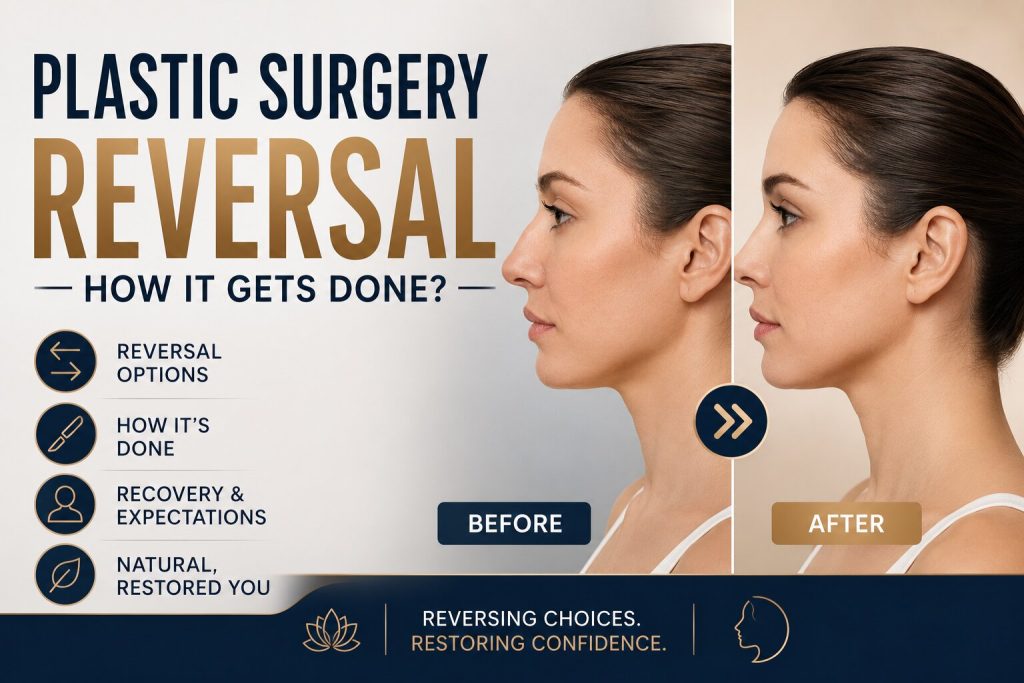
Most patients don’t walk into my office asking for plastic surgery reversal. They walk in asking if I can undo what someone else did.
That wording matters because it tells me how they’re thinking about the problem. They’re hoping there’s a reset button. That somehow we can erase scars, restore untouched anatomy, and go back to the way things were before the first operation.
I usually stop them there. “Let’s talk about what you’re really trying to fix.”
Because once surgery changes your anatomy, there’s no such thing as going backward. Skin has been lifted. Fat has been removed or repositioned. Scar tissue has formed. Blood vessels have adapted. Your body has already written part of the story.
Plastic surgery cannot usually be reversed completely, but plastic surgery reversal can often improve contour irregularities, asymmetry, excess skin, scarring, or dissatisfaction with a previous result.1
My job isn’t to erase that history. My job is to understand it well enough to improve it safely. That’s a very different operation.
Can Plastic Surgery Be Reversed?
Plastic surgery cannot usually be completely reversed.1 Patients often imagine revision surgery as pressing an undo button. In reality, revision surgery is closer to remodeling a house that has already been renovated once. The foundation has changed. The walls may have shifted. Some options that existed originally may no longer be available. The same principle applies to the human body.
After surgery, scar tissue develops, anatomical planes become less distinct, and circulation patterns adapt to support healing.2 This is why revision surgery requires different planning than primary surgery. The goal is not to recreate the past. The goal is to improve the present anatomy safely.
Before I Talk About Surgery, I Talk About Expectations
Patients are often surprised that I spend more time asking questions than examining them. “What bothers you the most?” “When did you first notice it?” “Has it always looked this way, or did it change over time?”
Those answers tell me more than measurements ever will. Sometimes the issue is obvious — a contour deformity after liposuction, an abdominal scar healing under excessive tension, or breasts that settled differently during recovery.
Other times, the surgery isn’t actually the problem. The expectation is. I’ve had patients show me technically beautiful surgical results and tell me they hate them. I’ve also had patients with visible imperfections tell me they’re thrilled. The anatomy may be similar. The perception isn’t. That’s why plastic surgery reversal starts with understanding the patient, not scheduling another operation.
What’s the Biggest Mistake I See?
The biggest mistake I see is operating too soon. Body contouring surgery is performed on a patient. After six weeks, they aren’t sure something has gone wrong because one side is thicker or the scar is firm. My approach is exactly the opposite.
I tell them the same thing I tell almost every revision patient: “I’d rather lose six months than lose healthy tissue.”
Scar tissue changes continuously during the first year after surgery.3 Swelling disappears in stages. Skin relaxes. Fat settles. Internal tissues soften. What patients see at six weeks is often very different from what they’ll see at six months. If I operate while those tissues are still evolving, I’m operating on anatomy that hasn’t finished healing.
Why Surgeons Often Recommend Waiting Before Revision Surgery
Research and clinical experience both support allowing tissues sufficient time to mature before pursuing revision surgery.3 Several biological processes continue long after the incision appears healed.
Persistent Swelling
Swelling can last for months. One side may temporarily appear larger than the other. Final contours often emerge gradually rather than immediately.
Scar Maturation
Scar tissue continues to remodel long after surgery. Scars that feel firm or raised early in recovery frequently soften over time.3
Tissue Stabilization
Skin relaxation continues. Internal structures settle. Areas that appear uneven early in healing may improve naturally.
Better Surgical Planning
Mature tissues provide a more accurate roadmap. Once healing stabilizes, surgeons can better distinguish between temporary changes and true anatomical problems requiring correction.2
For many patients, waiting several months isn’t delaying treatment. It is the treatment.
Why Revision Surgery Is Harder Than the Original Operation
One misconception I hear often is: “Just go back through the same incision.” If only it were that simple. Revision surgery is rarely a repeat of the original operation. It’s usually more difficult.
During a primary procedure, surgeons work within relatively predictable tissue planes. Structures separate more easily. Blood vessels generally follow expected pathways. Skin circulation is more reliable. Revision surgery changes that. Scar tissue forms between layers that were once separate. Normal anatomical planes become less distinct. Blood vessels may no longer follow their original course.2
What looked straightforward on a photograph or MRI can feel completely different once surgery begins. That’s why revision procedures often take longer than patients expect. I’m moving more carefully, protecting tissue that has already been through surgery, and making decisions based on what I actually find — not what I expected to find before the first incision. That’s one reason revision surgery demands flexibility just as much as technical skill.
Why Blood Supply Matters More Than Symmetry
Patients often focus on symmetry. Surgeons focus on circulation. Those priorities don’t always align. Someone may come into my office wanting me to correct a small contour difference between two sides. The question I ask myself isn’t: “Can I improve the symmetry?” The question is: “Can I improve it without compromising blood supply?”
Every operation affects circulation. Every incision alters blood flow. Every time tissue is elevated, its vascular reliability changes.1
One lesson I’ve learned treating complex revision and higher-BMI patients is that perfect symmetry means very little if tissue healing becomes compromised afterward. I’d rather accept a small imperfection than create a wound-healing problem that could have been avoided. A successful revision isn’t always the most aggressive correction. Often it’s the safest correction.
What I Learn From Previous Operative Reports
Whenever possible, I review previous operative reports before recommending revision surgery. The report tells me things photographs cannot — how much fat was removed, where tissue was elevated, whether muscle repair was performed, how incisions were designed, whether complications occurred during surgery, and which anatomical areas received the most surgical manipulation.2
That information helps me understand how the tissues were treated before I ever enter the operating room. In revision surgery, history matters. Good surgical planning starts by understanding that history.
Revision Surgery Isn’t About Making You Perfect
One thing I’ve learned after operating on higher-BMI and post-bariatric patients for decades is that perfection is usually the wrong goal. Balance is the right one.
Every incision creates new scar tissue. Every dissection changes the blood supply. Every revision removes another layer of surgical options if something doesn’t heal exactly as planned.3 Patients often think another operation is simply another opportunity. Surgeons know it’s also another risk. That’s why saying yes is easy. Knowing when to say no takes experience.
What Types of Plastic Surgery Can Be Revised?
Many patients think revision surgery is only for procedures that have “gone wrong.” That’s not necessarily true. Many patients opt for revision surgery due to body changes, changes in goals, or unexpected healing.1
Liposuction
Contour irregularities, asymmetry, residual fat deposits, or weight-related changes may sometimes be improved with additional contouring. Learn more about plus size liposuction.
Tummy Tuck Surgery
Patients might request revision for concerns about scars, recurrent skin laxity, contour irregularities, or changes after major weight loss or gain.
Breast Surgery
Breast augmentation, breast reduction, and breast lift surgery may need to be revised due to implant complications, asymmetry, body changes, or aging.
Post-Bariatric Body Contouring
Patients with significant weight gain or loss after surgery may develop new areas of skin laxity that were not present at the time of the original surgery.
The important distinction is that revision surgery is not always correcting a mistake. Sometimes it’s responding to how the body changed after the original operation.
Liposuction Is One of the Procedures Patients Most Want to “Redo”
“I’ve gained weight. Can you just liposuction the same areas again?”
I hear that question all the time. The answer depends entirely on why the body changed. The fat cells removed during liposuction are permanently removed. What happens instead is that the remaining fat cells enlarge if a person gains weight after surgery.1
When we compare images objectively, the treated areas often still look significantly better than they did before surgery. The procedure didn’t stop working. The body changed afterward. That’s an important distinction because it determines whether another operation will actually solve the problem. If the issue is substantial weight gain, repeating liposuction without addressing the weight often leads to another disappointment. If the issue is a true contour irregularity or an area that couldn’t be safely treated during the original procedure, that’s a completely different discussion.
Scar Tissue Doesn’t Behave Like Normal Tissue
Many patients assume scar tissue is simply thicker skin. It’s much more complex than that. Scar tissue represents a biological repair process that changes how tissues move, separate, and receive blood flow.3
Normal anatomical planes become less defined. Structures that once separated easily may now be firmly attached. Blood vessels can develop new pathways that didn’t exist before surgery. This is why revision surgery frequently requires slower dissection and more cautious tissue handling than primary surgery. That unpredictability is part of revision surgery. It’s also one reason experience matters.
Why High-BMI Revision Surgery Requires a Different Mindset
Often, patients come to me after someone has told them they are “too large” for revision surgery. I’d prefer to work on someone who has a BMI of 42, who is exercising, who doesn’t smoke, and who has good cardiovascular control — rather than someone who has a BMI of 31 who is gaining weight, has poorly controlled diabetes, and thinks surgery will replace lifestyle changes.
Those patients carry very different risks despite what the number on the chart suggests. BMI is a screening tool. It is not a surgical diagnosis.2
When evaluating higher-BMI patients, I pay close attention to weight stability, tissue quality (skin tension tolerance and circulation reliability), metabolic health (diabetes control, cardiovascular fitness, nutritional status), and surgical goals including functional concerns, excess skin removal, and contour correction.
Higher BMI changes how I plan surgery. It does not automatically eliminate surgery. The operation becomes less about removing the maximum amount of tissue and more about protecting circulation, preserving healthy skin, limiting operative time, and making decisions the body can realistically recover from.
The Consultation Is the Most Important Part of Plastic Surgery Reversal
Patients sometimes think the consultation is simply the first step toward scheduling surgery. I see it differently. The consultation is where I decide whether surgery should happen at all. That’s when I review previous operative reports if available, compare photographs, examine scars, assess tissue quality, and evaluate contour changes.
Most importantly, I ask questions that may not seem related until patients understand why I’m asking them: What outcome were you originally expecting? Has your health changed since the procedure? I want patients to understand that waiting isn’t doing nothing. Sometimes it’s the safest treatment I can offer.3
When Is Revision Surgery Worth Considering?
Not every dissatisfaction requires another operation. In my practice, revision surgery is most worth considering when there is a significant contour deformity, asymmetry affects appearance or function, excess skin creates discomfort, scar position causes problems, weight has remained stable, healing has fully matured, and the patient has realistic expectations.1
On the other hand, revision surgery may not be the right choice when a patient expects perfection, is still experiencing active healing changes, or is asking surgery to solve problems that are not truly surgical. The patients who do best are not necessarily the ones with the biggest deformities. They’re the patients who clearly understand both the possibilities and the limitations of another operation.
The Bottom Line
Plastic surgery generally cannot be completely undone, but many results can be safely improved through revision surgery.1,2 The goal is not to erase the first operation, but to achieve a better outcome based on your anatomy, healing, and overall health. For higher-BMI patients especially, successful plastic surgery reversal depends on choosing the right procedure at the right time — not simply performing another surgery.
Frequently Asked Questions
Can plastic surgery be completely undone?
No. Plastic surgery permanently changes tissues, anatomy, and scar formation. Revision plastic surgery can often improve results, but it generally cannot restore the body to its exact pre-surgical state.1
Does a high BMI automatically disqualify someone from revision surgery?
No. BMI is one factor among many. Overall health, weight stability, smoking status, nutritional health, cardiovascular fitness, and surgical goals often provide a more complete picture of risk than BMI alone.2
Will revision surgery remove all scars?
No. Revision surgery can sometimes improve the appearance of scars or reposition them, but surgery itself creates additional scars. The goal is improvement, not complete scar elimination.3
References (AMA Style)
- Janis JE, ed. Essentials of Plastic Surgery. 3rd ed. CRC Press; 2022. https://www.routledge.com/Essentials-of-Plastic-Surgery/Janis/p/book/9781496388254
- Neligan PC, ed. Plastic Surgery. 5th ed. Elsevier; 2024. https://www.elsevier.com/books/plastic-surgery/neligan/978-0-323-88387-0
- Atiyeh BS, Costagliola M, Hayek SN. Keloid and hypertrophic scars: the state of the art. Aesthetic Plast Surg. 2005;29(2):122–135. doi:10.1007/s00266-004-7609-0. https://link.springer.com/article/10.1007/s00266-004-7609-0