

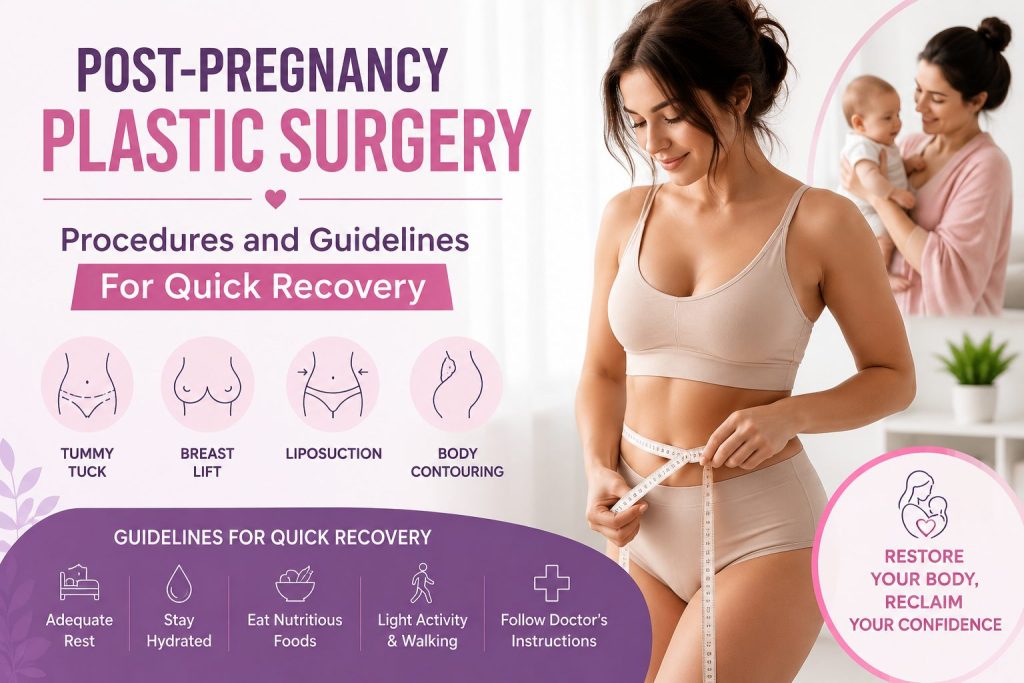
You lose the pregnancy weight. You start exercising again. You clean up your diet. You finally feel like yourself. Then you look in the mirror and realize you need post-pregnancy plastic surgery because the weight may be gone, but your body still doesn’t look the way it did before pregnancy.
Your stomach may still protrude despite countless core workouts. Your breasts may look deflated or sit lower than they once did. Fat may seem permanently attached to your waist, hips, or thighs, no matter how disciplined you are with nutrition and exercise.
With more than 20 years of surgical experience, I have helped thousands of women address the physical changes that remain after pregnancy, childbirth, and breastfeeding. One of the biggest misconceptions I encounter is that losing the pregnancy weight automatically restores the body to its pre-pregnancy appearance.
In fact, many of the changes that pregnancy brings about are structural — the skin, muscles, connective tissue, and breast anatomy — rather than just excess weight. This is crucial because finding out exactly what has changed and why is the first step to the best post-pregnancy plastic surgery procedure.
Those who tend to do best are the patients who are medically healthy, weight stable, and ready for recovery — all of these factors have a greater impact than any single measurement on safety and long-term outcomes.1
Quick Answer: What Is the Best Post-Pregnancy Procedure?
There is no single best post-pregnancy procedure. The right treatment depends on whether pregnancy left you with loose skin, muscle separation, stubborn fat deposits, breast sagging, breast volume loss, or a combination of several concerns. In my practice, the most successful outcomes occur when we identify the actual source of the problem rather than assuming every post-pregnancy concern requires the same operation.
Pregnancy Changes More Than Your Weight
One of the most common conversations I have with mothers begins the same way. They tell me: “I lost the baby weight, but my body still doesn’t look the same.” The scale may show a number they’re happy with, yet their abdomen still protrudes. Their waistline feels wider. Their clothing fits differently. Their breasts appear deflated or lower than they remember.
This occurs because not only does body weight change during pregnancy, but the body changes too. During pregnancy, the abdominal wall undergoes significant stretching. This can leave excess skin with reduced elasticity and cause separation of the rectus abdominis muscles, known as diastasis recti.2 Breast tissue increases, then decreases in volume post-breastfeeding. Hormones can also affect the distribution of fat in the body.
The abdomen influences the waistline. The waistline influences hip proportions. Breast volume affects upper-body balance. This is why proper planning is essential to successful body contouring — not focusing on one body part in isolation.
What Is a Post-Pregnancy Body Contouring Procedure?
A post-pregnancy body contouring procedure is a surgical procedure used to correct physical changes that have occurred as a result of pregnancy and breastfeeding. These procedures may remove excess skin, repair abdominal muscle separation, reduce stubborn fat deposits, restore breast shape and position, and improve overall body proportions. The aim is to improve the contours affected by pregnancy that diet and exercise alone cannot correct.
Why Weight Loss Isn’t Always a Solution to the Problem
Fat and loose skin do not mean the same thing. Many women spend months doing stomach workouts hoping to eliminate abdominal projection, only to feel frustrated because their fitness improves while the protrusion remains.
In these situations, I often find that the issue is not excess fat at all. Instead, it may be excess skin, diastasis recti, abdominal wall laxity, or structural changes in tissue support. No amount of dieting removes loose skin. No amount of exercise repairs significant muscle separation.2 Understanding that difference helps us select the most effective procedure rather than performing surgery that fails to address the actual problem.
Why Muscle Repair Is Ideal for Moms Getting a Tummy Tuck Post-Pregnancy
Diastasis recti is one of the most frequent pregnancy side effects for which women seek a tummy tuck. As a woman’s abdomen grows, the rectus muscles begin to separate.2
Patients often describe persistent lower abdominal bulging, core weakness, and difficulty achieving a flatter stomach despite exercise. A tummy tuck allows me to address multiple concerns simultaneously: repair muscle separation, tighten the abdominal wall, remove excess skin, and improve abdominal contour.
What makes this procedure particularly effective is that it addresses the structural changes pregnancy created rather than simply reducing fat. In my experience, this often produces the most dramatic improvement for mothers whose primary concern is abdominal shape rather than body weight.
Common Post-Pregnancy Concerns and Their Surgical Solutions
| Concern | Common Procedure |
|---|---|
| Loose abdominal skin | Tummy Tuck |
| Diastasis Recti | Tummy Tuck With Muscle Repair |
| Stubborn Fat Deposits | Liposuction |
| Breast Sagging | Breast Lift |
| Breast Volume Loss | Breast Augmentation |
| Multiple Concerns | Mommy Makeover |
This is one reason there is no universal best post-pregnancy plastic surgery procedure. Different anatomical problems require different solutions.
If Stubborn Fat Is the Primary Concern
Not every mother who visits my office needs a tummy tuck. In fact, one of the most important parts of consultation is determining whether the concern is primarily structural or simply related to localized fat deposits. Some women have excellent skin quality, minimal muscle separation, and good abdominal support — yet they continue to struggle with areas of fat resistant to healthy habits.
The most common areas include the waist, flanks, lower abdomen, back, hips, thighs, and upper arms. In these situations, liposuction may be the most effective solution.
Why Liposuction Works for Some Mothers and Not Others
If the concern is primarily excess fat, contour improvement can be achieved through liposuction. Removing fat alone may not yield the result a patient is hoping for when the main concern is loose skin or abdominal laxity.1 This is why I spend much of my examination assessing tissue consistency, not just the amount of fat. Good surgical planning involves identifying the true source of the contour issue before recommending treatment.
Liposuction Is a Contouring Procedure, Not a Weight-Loss Procedure
Liposuction is designed to improve shape and proportion. It is not intended to treat obesity or replace healthy lifestyle habits. The best candidates are generally patients who are close to a stable weight, have good skin elasticity, have localized fat deposits, and maintain realistic expectations.
If Your Breasts No Longer Look the Same
Breast changes are among the most common post-pregnancy concerns I see. Many women are surprised by how dramatically pregnancy and breastfeeding can affect breast shape. Some patients describe loss of upper fullness, deflation after breastfeeding, sagging skin, and asymmetry.
While these concerns may appear similar on the surface, the underlying anatomy is often very different. This is why I avoid recommending breast procedures before performing a detailed examination. Two women may describe the exact same complaint but require completely different surgical plans.
Why Women Experiencing Breast Changes After Breastfeeding Often Consider Breast Lift Surgery
One pattern I frequently observe is that women are not necessarily bothered by breast size — they are bothered by breast position. Pregnancy stretches the skin envelope that supports the breast. After breastfeeding, volume often decreases while the stretched skin remains. This can create sagging, loss of shape, and downward nipple positioning.
When position is the primary issue, a breast lift is often the most appropriate solution. A breast lift allows me to reposition breast tissue, improve breast shape, and create a more youthful contour. The goal is not simply lifting tissue — the goal is restoring proportion and balance.
When Breast Augmentation Makes More Sense
Some women are happy with breast position but miss the fullness they had before pregnancy. In these cases, volume loss may be the primary concern. Breast augmentation can help restore upper pole fullness, breast projection, and volume lost after breastfeeding. For many mothers, the ideal result actually comes from combining a breast lift with breast augmentation. Anatomy determines the operation, not the complaint.
When a Mommy Makeover Makes Sense
The phrase “Mommy Makeover” is one of the most misunderstood terms in plastic surgery. Many patients assume it refers to a specific procedure. It doesn’t. A Mommy Makeover is simply a customized surgical plan designed to address multiple post-pregnancy concerns during one coordinated treatment strategy.
Why I View Pregnancy Changes as a Connected System
One lesson I have learned after treating thousands of body contouring patients is that pregnancy rarely affects only one area. A woman may come in concerned about her abdomen, but after evaluation we discover that abdominal laxity affects waist definition, waist shape affects hip balance, and breast changes affect upper-body proportion.
Treating these concerns independently can sometimes create an incomplete result. This is why I often approach post-pregnancy plastic surgery as a comprehensive system rather than a collection of isolated procedures.1 The question is not simply: “What area bothers you?” The question is: “How do these changes interact with one another?” That perspective frequently leads to more balanced and natural-looking outcomes.
Common Mommy Makeover Combinations
One patient may require a tummy tuck, liposuction, and breast lift. Another may benefit from breast augmentation and liposuction. A third may require a tummy tuck, breast lift, and fat reduction along the waistline. The best Mommy Makeover is not a package. It is a personalized treatment plan built around anatomy, safety, and recovery considerations.
Why Timing Matters More Than Most Mothers Realize
One of the first questions I ask is: “Are you finished having children?” Future pregnancies can alter surgical results and reverse many of the improvements achieved through body contouring procedures. That doesn’t mean future surgery becomes impossible — it simply means timing plays an important role in long-term satisfaction.
How Long Should You Wait After Pregnancy?
The body continues to change for months after childbirth. Hormones stabilize. Breast tissue evolves. Skin retracts. Weight settles. Rushing into surgery before these changes occur can make planning less predictable. Most patients benefit from waiting until breastfeeding has ended, weight has stabilized, and hormonal changes have largely settled. This allows us to evaluate anatomy more accurately and create a more durable surgical plan.
Post-Pregnancy Surgery Timeline
| Stage | Recommendation |
|---|---|
| Immediately After Birth | Recovery and healing |
| During Breastfeeding | Allow breast anatomy to stabilize |
| After Breastfeeding Ends | Reassess breast and body changes |
| Stable Weight Achieved | Consultation for surgery |
| Finished Having Children | Ideal timing for long-term results |
Post-Pregnancy Body Contouring in Miami
In my Miami practice, one of the most common concerns I hear from mothers is that they have done everything right. They lost the pregnancy weight. They returned to the gym. They made significant improvements to their diet. However, they still feel some parts of their body are not a reflection of their efforts. In most cases, it is not the lack of motivation. It is anatomy. That distinction helps us refine our attention to procedures that address structural changes rather than simply further weight loss.
Who Is a Good Candidate for Post-Pregnancy Procedures?
The ideal candidate is not necessarily the patient with the lowest BMI — this is something I discuss frequently during consultation. Successful outcomes depend far more on overall health, stability, and tissue characteristics than on a single number.1
Generally, strong candidates have a stable weight, have completed breastfeeding, do not smoke, are medically healthy, have realistic expectations, understand the recovery process, and are bothered by physical changes that have not improved naturally.
Safety always comes first. The goal is not simply improving appearance. The goal is to achieve improvement responsibly while minimizing unnecessary risk. If you’re wondering what realistic outcomes may look like for patients with a higher BMI, viewing our Plus Size Tummy Tuck Before & After Gallery can provide helpful insight into the types of results that may be achievable with individualized surgical planning.
Understanding the Risks of Post-Pregnancy Procedures
Every surgical procedure carries risk. Part of responsible surgical planning is balancing potential benefits with those risks. Potential considerations may include bleeding, infection, delayed wound healing, fluid accumulation, scarring, anesthesia-related complications, and the need for future revision procedures.2
Certain factors may increase surgical risk, including smoking, uncontrolled medical conditions, and significant weight fluctuations. This is why candidacy is based on a comprehensive evaluation rather than appearance alone. A good surgical result begins with proper patient selection.
The Bottom Line
After more than 20 years of performing body contouring surgery, one thing has become very clear: there is no single best post-pregnancy plastic surgery. Every woman experiences pregnancy differently. Some mothers are primarily affected by loose skin. Others struggle with muscle separation. Some are frustrated by stubborn fat deposits despite maintaining a healthy lifestyle. Others are most concerned about changes in breast shape, position, or volume.
The best post-pregnancy procedures are the ones that address the actual anatomical changes present — not the ones that happen to be most popular online.1,2
My goal is not to create a different body. The goal is to help you reclaim the contours pregnancy changed while maintaining proportions that look natural and feel authentic to you.
Frequently Asked Questions
What are the best post-pregnancy procedures?
The best post-pregnancy procedures depend on the specific anatomical changes caused by pregnancy. Some women benefit most from a tummy tuck, while others achieve better results with liposuction, breast surgery, or a customized Mommy Makeover.1
Can exercise repair diastasis recti after pregnancy?
Exercise can strengthen the abdominal wall, but significant muscle separation often cannot be fully corrected through exercise alone. In some patients, surgical repair performed during a tummy tuck may be necessary to restore support and contour.2
References (AMA Style)
- Mommers EH, Ponten JEH, Al Omar AK, de Vries Reilingh TS, Bouvy ND, Nienhuijs SW. The general surgeon’s perspective of rectus diastasis: a systematic review of treatment options. Surg Endosc. 2017;31(12):4934–4949. doi:10.1007/s00464-017-5607-9. https://link.springer.com/article/10.1007/s00464-017-5607-9
- Hickey F, Finch JG, Khanna A. A systematic review on the outcomes of correction of diastasis of the recti. Hernia. 2011;15(6):607–614. doi:10.1007/s10029-011-0839-4. https://link.springer.com/article/10.1007/s10029-011-0839-4