

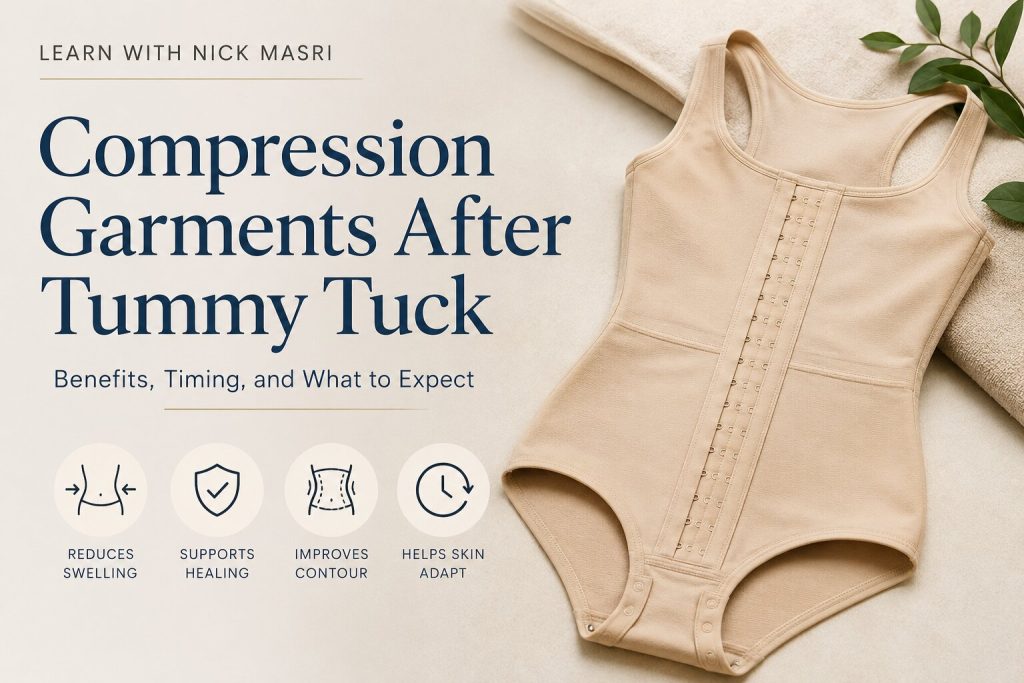
One of the first questions patients ask me after surgery isn’t about their scar. It’s about the garment. “Do I really have to wear this?” My answer is almost always the same. Yes, but not simply because it’s part of the routine. I recommend compression garments after tummy tuck surgery because they serve a genuine medical purpose during recovery.
They provide gentle support while your body heals after excess skin has been removed, the abdominal wall has been repaired, and the remaining tissues are adapting to their new position.1
Many patients believe the garment is designed to make their waist smaller or improve their cosmetic result. That’s a common misconception. The contour of your abdomen is created in the operating room, not by the garment you wear afterward. Instead, a properly fitted compression garment helps protect the work already performed by supporting healing tissues, reducing postoperative swelling, and making everyday movements more comfortable during the early recovery period.2
Patients who understand why they are wearing their garment — not just for the amount of time prescribed — end up with more confidence during recovery and are better equipped to manage the normal changes that occur as swelling gradually resolves.
Recovery isn’t passive. These first few weeks are crucial for how your body heals and how your body feels.
Why Compression Matters After an Abdominoplasty
An abdominoplasty is much more than a skin-tightening procedure. During surgery, excess skin and subcutaneous fat are removed, the abdominal flap is carefully elevated, and when necessary, the separated abdominal muscles are repaired through fascial plication to restore strength and support along the midline. The remaining tissues are then repositioned before the incision is meticulously closed.1
The incision on the outside is what patients are aware of, but the majority of healing is taking place under the skin. The body enters the inflammatory stage of wound healing right after surgery. Blood vessels become more permeable, letting fluid and immune cells enter the surgical area. This is necessary for healing but can also lead to postoperative swelling.
Some swelling is normal following tummy tuck surgery. The goal isn’t to eliminate it completely. The goal is to control it while the elevated tissues reconnect and the surgically created space gradually closes. This is where compression garments after tummy tuck become an important part of postoperative care.2
When properly fitted, a medical garment applies even pressure while keeping the area supported without being too restrictive. This external support helps prevent excessive fluid buildup in the surgical space, limit unnecessary movement of the abdominal flap, and make routine activities such as standing, walking, coughing, or getting out of bed much more manageable.
What Does a Compression Garment Actually Do?
Unlike regular shapewear, a medical compression garment provides controlled pressure with even distribution for recovery without compromising normal blood flow.1
When fitted correctly, a compression garment can help support the repaired abdominal wall after muscle plication, reduce postoperative swelling and tissue edema, limit fluid accumulation within the surgical space, decrease unnecessary movement of the abdominal flap, improve comfort during standing, walking, and coughing, and provide gentle support while tissues reconnect naturally.
It is equally important to understand what compression does not do. It does not remove fat. It does not tighten loose skin. It does not create muscle definition. Those improvements were achieved during surgery. The garment simply protects those results while your body heals.
Not Every Compression Garment Is the Same
A common misconception is that any abdominal binder or compression garment purchased online provides the same benefit. Choosing the wrong garment can create unnecessary problems.2
A garment that is too tight may restrict circulation, increase discomfort, create pressure points, irritate the incision, leave deep indentations in healing tissue, and make patients less likely to wear it consistently. A garment that is too loose creates the opposite problem — without adequate support, the abdominal tissues move more during everyday activity, reducing many of the benefits compression is intended to provide.
This is why I don’t recommend selecting compression based solely on size charts or online reviews. The appropriate garment depends on the extent of skin removal, whether muscle repair was performed, the amount of postoperative swelling, your body habitus and tissue quality, and whether surgery included additional body contouring procedures.
Patients recovering from an extended abdominoplasty or circumferential body contouring often require a different postoperative garment than someone recovering from a standard tummy tuck. Every surgical plan is individualized. Your recovery should be as well.
The Biggest Mistake Patients Make During Recovery
One of the most common mistakes I see isn’t wearing the wrong garment — it’s the belief that more compression equals better results. Patients often notice their abdomen beginning to look flatter as swelling gradually improves and assume that switching to a smaller or tighter garment will accelerate their results. Unfortunately, healing doesn’t work that way.
Compression should not be tight or constricting. The healing tissues need healthy blood flow to deliver oxygen, nutrients, and immune cells to repair the surgical wound. Too much compression can put undue stress on healing tissues, cause pain, and may make the patient less willing to wear the garment consistently.1
Another mistake is treating compression like an optional part of recovery. Some patients wear their garment continuously for the first week but begin removing it for long periods because they “feel fine.” Healing, however, continues long after discomfort improves. Collagen remodeling, lymphatic drainage, and scar maturation continue for weeks and even months after surgery. During this early phase, consistent support is usually far more beneficial than increasing the amount of compression itself.2
The patients who follow through are consistently the ones who have the smoothest recovery. Your body already knows how to heal. Our goal is simply to create the best possible environment for it to do so.
How Long Should You Wear Compression Garments After a Tummy Tuck?
During almost every postoperative visit I am asked: “How long will I need to wear my compression garment?” There isn’t one answer that applies to every patient.
Patients often look online hoping to find a standard timeline. The problem is that healing isn’t standardized.1 Someone undergoing a straightforward abdominoplasty without muscle repair will usually recover differently from someone who has undergone an extended tummy tuck, abdominal wall plication, or multiple body contouring procedures during the same operation.
Several factors influence how long postoperative compression remains beneficial, including whether abdominal muscle repair was performed, the amount of excess skin removed, the extent of postoperative swelling, tissue quality and skin elasticity, overall healing progress, whether additional body contouring procedures were performed simultaneously, and the presence of comorbid conditions such as diabetes that may affect wound healing.2
I don’t stop compression because four weeks have passed. I stop compression because your tissues tell me they’re ready. Likewise, if swelling increases after reducing compression, I may recommend continuing support a little longer. Recovery should follow your body, not a date on the calendar.
The Role of Compression in High-BMI and Post-Weight-Loss Patients
Patients with higher BMIs or those who have lost a considerable amount of weight may need a more personalized recovery plan. This isn’t simply because of BMI — it’s because they are anatomically different. Once significant weight loss has taken place, the skin has often been stretched over several years before losing its natural elasticity.
The excess tissue may cover the abdomen and flanks, hips, mons pubis, lower back, and upper thighs, resulting in a significantly larger area of excess skin requiring surgical correction. Swelling can occur across multiple anatomical areas in addition to the lower abdomen. Longer incisions result in more tension on the skin, and larger portions of elevated skin require more support during healing.2
For these patients, compression garments after tummy tuck surgery become an important component of the overall recovery strategy because they help stabilize tissues across a broader operative field while postoperative swelling gradually subsides.
One point I make to every patient: no compression will compensate for a poor surgical candidate. None of the garments can help a person with uncontrolled diabetes, smoking, poor weight control, extreme nutritional deficiencies, or undiagnosed medical problems that affect healing. Body contouring surgery success starts before the procedure.
How Should a Tummy Tuck Compression Garment Fit?
One of the simplest ways I explain proper fit is this: your garment should feel supportive, not painful. Patients should notice gentle, even pressure around the abdomen without feeling restricted. You should be able to breathe comfortably, walk normally, and sit without significant discomfort. If your garment creates pain rather than support, it may not fit correctly.1
Signs Your Compression Garment Fits Properly
A properly fitted compression garment after tummy tuck should apply even pressure across the abdomen, support the repaired abdominal wall, feel snug without restricting breathing, allow comfortable walking and standing, and stay in position without excessive rolling or bunching.
Warning Signs Your Garment May Be Too Tight
Contact your surgical team if you experience increasing pain while wearing the garment, numbness or persistent tingling, difficulty taking deep breaths, openings in the incision where the garment lands, skin irritation or breakdown, deep indentations that remain long after the garment is removed, or new swelling above or below the garment edges.2
Patients sometimes believe these symptoms indicate the garment is “working.” In reality, they often indicate excessive compression. The objective isn’t to flatten your abdomen by force. The objective is to provide stable, comfortable support while healing progresses naturally.
Your Final Result Depends on More Than Compression
Patients naturally focus on every detail after surgery because they want the best possible outcome. Recovery plays a meaningful role in your overall experience. However, no single part of recovery determines the final result. A compression garment is one piece of a much larger plan.
Your long-term outcome depends on the quality of your skin and underlying tissues, the surgical technique used, whether abdominal muscle repair was performed, the amount of excess skin and fat removed, your body’s natural healing response, maintaining a stable weight after surgery, following postoperative instructions consistently, and attending scheduled follow-up visits.2
The garment supports the healing process. It does not replace careful surgery. It does not replace healthy habits. And it certainly cannot compensate for smoking, significant weight fluctuations, uncontrolled medical conditions, or returning to strenuous activity too early.
Long after swelling improves, your body continues remodeling collagen, strengthening the abdominal wall, restoring lymphatic drainage, and maturing scars — changes that continue for many months after surgery. The best results usually come from patients who allow healing to occur at its own pace instead of trying to rush the process.3
My Approach to Compression After Abdominoplasty
No two abdominoplasties are identical. A patient undergoing a limited lower-abdominal skin excision without muscle repair has different postoperative needs than someone undergoing an extended abdominoplasty after major weight loss with rectus plication and circumferential tissue laxity. That’s why I individualize postoperative care.
When I recommend a tummy tuck compression garment, I’m considering the quality of your tissues, the amount of tension across the incision, whether muscle repair was performed, the extent of skin elevation, your overall medical condition, and how your healing progresses at each follow-up visit.3
My goal isn’t simply to tell you to wear compression for a certain number of weeks. My goal is to guide you safely through recovery while giving your tissues the support they need to heal as predictably as possible. Every recommendation should fit the patient, not the other way around.
Browse our plus-size surgery before-and-after gallery to see real patient outcomes following abdominoplasty.
The Bottom Line
Compression garments after tummy tuck surgery remain an important part of recovery because they provide gentle external support while your body heals from abdominoplasty. When properly fitted and worn according to your surgeon’s instructions, they can help reduce postoperative swelling, stabilize healing tissues, improve comfort during movement, and support the abdominal wall as it recovers.3
What they cannot do is create your surgical result. The contour you see after recovery is created through careful surgical planning, meticulous technique, and your body’s natural healing process. Compression simply helps protect that investment.
When you understand the purpose of compression garments after tummy tuck surgery and use them correctly, you’re giving your body the support it needs to heal safely, comfortably, and as predictably as possible.
Frequently Asked Questions
How long should I wear compression garments after tummy tuck surgery?
The appropriate duration varies from one patient to another. Most patients wear their compression garments after tummy tuck continuously during the early weeks of recovery, when swelling is greatest. Your surgeon will determine when compression can be reduced based on your healing progress, tissue stability, and physical examination rather than a fixed timeline.1
Can wearing a tighter compression garment improve my tummy tuck results?
No. Excessively tight compression does not create a flatter abdomen or improve your surgical outcome. Instead, it may reduce comfort, restrict circulation, and place unnecessary pressure on healing tissues. A properly fitted medical-grade garment should provide gentle, even support rather than excessive compression.2,3
References (AMA Style)
- American Society of Plastic Surgeons. Tummy tuck (abdominoplasty). American Society of Plastic Surgeons. Updated 2024. Accessed July 17, 2026. https://www.plasticsurgery.org/cosmetic-procedures/tummy-tuck
- Janis JE, Harrison B. Wound healing: Part I. Basic science. Plast Reconstr Surg. 2016;138(3 Suppl):9S–17S. doi:10.1097/PRS.0000000000002680. https://journals.lww.com/plasreconsurg/fulltext/2016/09001/wound_healing__part_i__basic_science.3.aspx
- Janis JE, Harrison B. Wound healing: Part II. Clinical applications. Plast Reconstr Surg. 2016;138(3 Suppl):18S–28S. doi:10.1097/PRS.0000000000002681. https://journals.lww.com/plasreconsurg/fulltext/2016/09001/wound_healing__part_ii__clinical_applications.4.aspx