

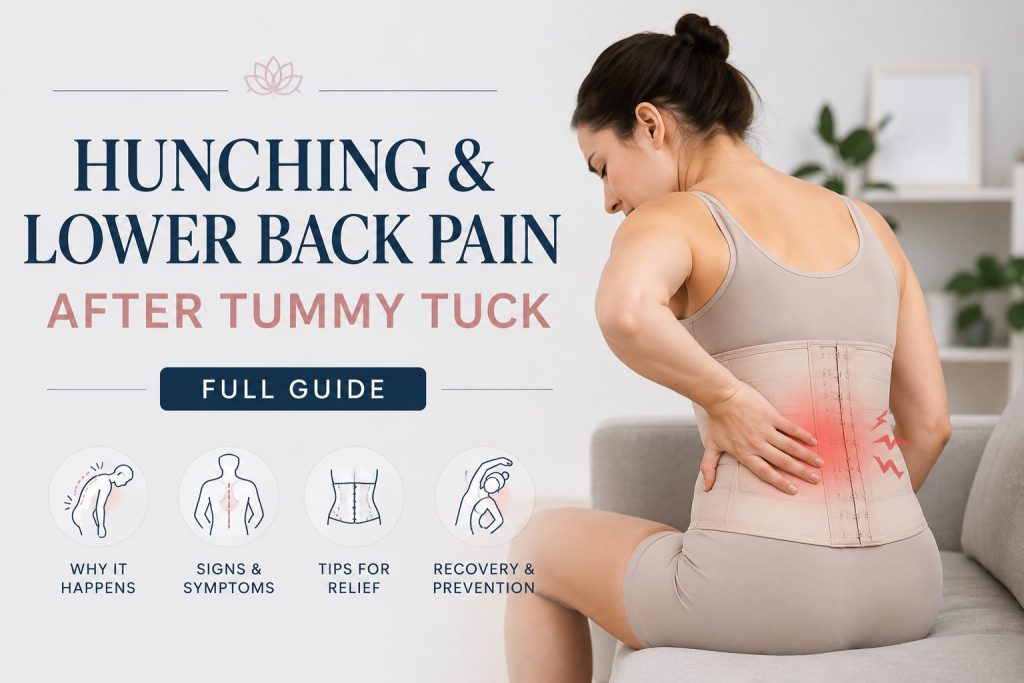
If you’re experiencing back pain after tummy tuck, one of the first things I want you to know is this: in most cases, it doesn’t mean something has gone wrong. In fact, one of the most common questions I hear after surgery is: “Why can’t I stand up straight?”
Patients expect soreness in their abdomen. They expect swelling and bruising. What often surprises them is that their lower back hurts more than their stomach, especially during the first week. That reaction is understandable.
When you wake up after surgery and find yourself walking bent over, it’s easy to assume something isn’t healing properly. Fortunately, temporary hunching and back pain after tummy tuck are usually normal parts of the recovery process, particularly if I repaired your abdominal muscles or performed more extensive body contouring.1
Understanding why your body responds this way — and what I expect to see during recovery — helps take much of the anxiety out of those first few weeks.
Why Are You Walking Bent Over After a Tummy Tuck?
When I do a tummy tuck, I’m removing skin and gently closing the wound under tension. If the muscles in your abdomen have separated due to pregnancy, weight gain, weight loss, or aging, I may also repair the abdominal muscles to restore strength and support.2
As soon as surgery is done, everything feels tighter. That’s expected. Standing up straight right away would put freshly repaired tissues under strain. Walking in a slightly bent position reduces tension across the incision, decreases stress on the muscle repair, and allows you to move more comfortably during the earliest stage of recovery. Most postoperative recovery protocols encourage patients to gradually return to full extension rather than forcing an upright posture immediately.1
One of the things I remind my patients of is this: your posture will improve because your tissues heal, not because you force them to stretch.
Why Does Your Lower Back Hurt More Than Your Stomach?
This surprises people all the time. Patients come back to my office and say: “My stomach isn’t bothering me nearly as much as my back.” There’s a straightforward explanation for that.
If you walk hunched over, your lower back muscles are almost constantly engaged to maintain balance. Your abdomen, pelvis, hips, and lower back normally work together to stabilize your spine. While your abdomen is healing, you’re redistributing some of that load to your lower back in the short term. Those muscles get tired after several hours or several days.1
This is also related to the synergy between back muscles and abdominal muscles working together. The pain you experience is most likely muscle fatigue, not an issue with the surgery itself. Patients may report aching, tightness, or stiffness rather than a shooting or sharp pain. As your posture slowly returns to normal, those muscles gradually share the work with your recovering core, and the soreness tends to improve.
Why Muscle Repair Can Make Recovery Feel Different
Not every tummy tuck includes muscle repair. If I recommend repairing your abdominal muscles, I expect your recovery to feel different than someone who only had excess skin removed.
Pregnancy, major weight changes, and aging can stretch the connective tissue between the abdominal muscles, creating a condition called rectus diastasis. Repairing those muscles helps restore the support your core was designed to provide.2
Many people think muscle repair is only about creating a flatter stomach. That’s not how I look at it. When I repair the abdominal wall, I’m restoring function as well as appearance. A stronger abdominal wall provides better support for your core over the long term.
Immediately after surgery, however, that repair is intentionally tight. Because of that, I don’t expect you to stand completely upright in the first few days. I would rather see you protecting the repair than forcing your body into a position it isn’t ready for yet. Healing happens in stages. As swelling decreases and your tissues gradually relax, your posture almost always improves naturally. Trying to rush that process rarely helps.
What I Look For During Your Recovery
One of the biggest mistakes patients make is comparing themselves to someone else’s recovery online. Every tummy tuck is different. Everybody heals differently. When I see you after surgery, I’m not judging your recovery based on whether you can stand perfectly straight. I’m looking at the bigger picture — how your incision is healing, how much swelling is improving, whether the abdominal wall is under appropriate tension, your mobility from one visit to the next, how comfortable you’re becoming with everyday movement, and whether your recovery is steadily progressing in the right direction.1
Someone who had a small skin excision without muscle repair will often recover differently from someone who required significant abdominal tightening, liposuction, or extensive body contouring. That’s why I don’t believe in comparing patients to averages. I believe in following your recovery.
When Should You Stand Up Straight After a Tummy Tuck?
One of the questions I hear most often is: “When should I finally be standing up straight?” The answer is probably different from what you’ve read online. I don’t measure your recovery by how quickly you can stand perfectly upright. I measure it by how safely your tissues are healing.
I anticipate that many patients will be somewhat flexed for the first few days after surgery. This forward position helps reduce tension at the incision site and on any muscle repair. What matters is progress, not the endpoint. For some patients, there is considerable improvement within just a few weeks, and for others — especially those who had extensive muscle repair or larger body-contouring procedures — it may take several weeks before standing up straight feels natural.2
When Does Hunching and Back Pain After a Tummy Tuck Get Better?
During the early recovery period, some patients may notice back discomfort as the back muscles work harder to maintain posture while the abdominal wall heals.1
Weeks 2 to 3
As swelling subsides and your abdomen becomes more comfortable, most patients will naturally begin to stand taller. The lower back strain typically starts to improve as posture improves.
Weeks 4 to 6
At this point, many patients are able to stand upright without thinking about it. Back pain following a tummy tuck has improved or resolved for most, although those who have had extensive muscle repair or more complex body contouring may continue to notice gradual improvement.
The Months That Follow
Your body will continue healing internally for several months even after you are fully upright. Collagen remodeling, scar maturation, and tissue strengthening continue long after the initial recovery phase.2 I remind patients: I don’t judge recovery by the calendar. I judge it by whether you’re improving week after week. If you’re gradually standing taller, moving more comfortably, and becoming more active without increasing pain, your body is usually doing exactly what it’s supposed to do.
Does a Higher BMI Make Back Pain After Tummy Tuck Worse?
It can, but not simply because of BMI. In my practice, back pain after a tummy tuck is influenced far more by tissue characteristics, surgical complexity, muscle repair, and healing response than by a single BMI number alone.1
I’m much more interested in questions like: Where is the weight distributed? How healthy is the skin? How thick are the tissues I’m working with? Is most of the fat above the abdominal muscles or deeper inside the abdomen? Do the abdominal muscles require repair? Can I perform the operation safely while minimizing tension during closure? Are there any preexisting back conditions that could be exacerbated by the procedure or affect postoperative recovery?
Those answers tell me much more than BMI alone ever could. There have been plenty of patients with higher BMIs who recovered easily because their bodies were healthy, their condition was under control, and the surgery was planned around their anatomy. In my experience, patients with relatively lower BMIs may need a longer recovery if they have extensive muscle repair or a significant amount of skin removed. If you’re planning a plus size tummy tuck, understanding how recovery may differ — and why individualized surgical planning is far more important than BMI alone — is essential.
What Actually Helps Back Pain After a Tummy Tuck?
Patients often ask me if there’s a way to make recovery easier. The answer isn’t usually a new product or special exercise. It’s allowing your body to heal the way it was designed to.2
Here’s what I recommend to most patients: eat small, frequent meals rather than a single large one; change positions often and don’t leave the lower back muscles contracted for hours; if comfortable, sleep with your upper body and knees slightly raised in the first week of recovery; stay well hydrated; follow your compression garment’s directions for use; adhere to the postoperative medication plan; and wait until cleared to lift, push, or pull any heavy items. On occasion, muscle relaxers may be prescribed as well.
One of the best activities you can do is gentle movement. Walking improves circulation, helps reduce stiffness, supports good breathing after surgery, and helps reduce the risk of blood clots. Patients’ backs often feel better when they change positions during the day instead of staying in one position for extended periods.
What I Don’t Want You to Do
I don’t recommend forcing yourself upright before your body is ready, aggressive stretching during the first phase of healing, returning to strenuous exercise too early, ignoring pain that is getting progressively worse, or comparing your recovery to stories you read online or on social media.
Recovery isn’t about proving how tough you are. It’s about protecting the repair I performed so your long-term result has the best opportunity to heal beautifully.
When Back Pain After a Tummy Tuck Isn’t Normal
Most cases of back pain after a tummy tuck gradually improve as posture returns and the abdominal wall heals. There are situations, however, where I want patients to contact my office immediately.1
Please call your surgeon promptly if you experience back pain associated with shortness of breath (which may be a sign of a pulmonary embolism and requires immediate emergency evaluation), pain that becomes significantly worse instead of gradually improving, sharp pain shooting down one or both legs, new numbness or muscle weakness, fever or chills, increasing redness around the incision, thick or foul-smelling drainage, rapidly increasing swelling, or difficulty walking after previously improving.
Can a Tummy Tuck Eventually Improve Back Pain?
Interestingly, once recovery is complete, some patients tell me something I didn’t promise them before surgery: their back feels better. That doesn’t happen because a tummy tuck treats spinal problems.
When the abdominal muscles are weakened or separated, the lower back may compensate by working harder during standing, walking, and lifting. Repairing and restoring the abdominal wall distributes forces more evenly across the front of the body, which can reduce chronic muscular strain in some patients.2
I always advise patients, however, that a tummy tuck is not a remedy for arthritis, herniated discs, spinal stenosis, nerve compression, or other orthopedic issues.
The Consultation Matters More Than the Internet
I understand why patients spend hours searching online. You’re trying to figure out whether your recovery is “normal.” The problem is that the internet can’t tell you what happened during your operation. It doesn’t know whether I repaired your abdominal muscles, how much skin I removed, how much tension was present when I closed your incision, how your tissues looked in the operating room, or your preoperative medical history.1
Those details matter. A tummy tuck isn’t the same operation for every patient. Some procedures involve only skin removal. Others involve substantial muscle repair, revision surgery, or larger body contouring after significant weight loss. All of those factors alter my recovery expectations.
That is one of the reasons I don’t encourage patients to form opinions about their recovery from forums or social media. My assessment of your recovery will be based on your anatomy, your procedure, and your body’s healing. If you have back pain after tummy tuck or feel you are not progressing as expected, the first step is talking to the surgeon who knows what was done during your surgery — not searching for another opinion online.
If you’re still deciding whether this procedure is right for you, my comprehensive extended tummy tuck guide explains who is a candidate, what the surgery involves, and what you can realistically expect during recovery.
Frequently Asked Questions
Is back pain after a tummy tuck normal?
Yes. In most patients, back pain after tummy tuck is a normal part of recovery. It usually develops because the body naturally walks in a slightly bent position to protect the healing abdominal wall, placing additional strain on the lower back muscles. The discomfort generally improves as swelling decreases and posture gradually returns to normal.1 However, back pain accompanied by shortness of breath is not a normal part of recovery and should be evaluated promptly by a medical professional.
How long does back pain after a tummy tuck usually last?
Most patients notice gradual improvement over the first several weeks as they begin standing more upright. Recovery varies depending on factors such as muscle repair, the extent of surgery, swelling, and individual healing. Patients who undergo more extensive body contouring may require additional time before discomfort completely resolves.2
Can a tummy tuck permanently cure back pain?
No. A tummy tuck is not a treatment for spinal conditions such as arthritis, herniated discs, or nerve compression. However, repairing weakened abdominal muscles can improve core stability, and some patients notice less muscular lower back discomfort after fully recovering. Removal of a large pannus may also improve body mechanics and back pain in some cases.2
References (AMA Style)
- American Society of Plastic Surgeons. Tummy tuck (abdominoplasty). American Society of Plastic Surgeons. Updated 2024. Accessed June 28, 2026. https://www.plasticsurgery.org/cosmetic-procedures/tummy-tuck
- Stokes RB, Williams C. Abdominoplasty. In: StatPearls. Treasure Island, FL: StatPearls Publishing; Updated January 2025. Accessed June 28, 2026. https://www.ncbi.nlm.nih.gov/books/NBK431058/