

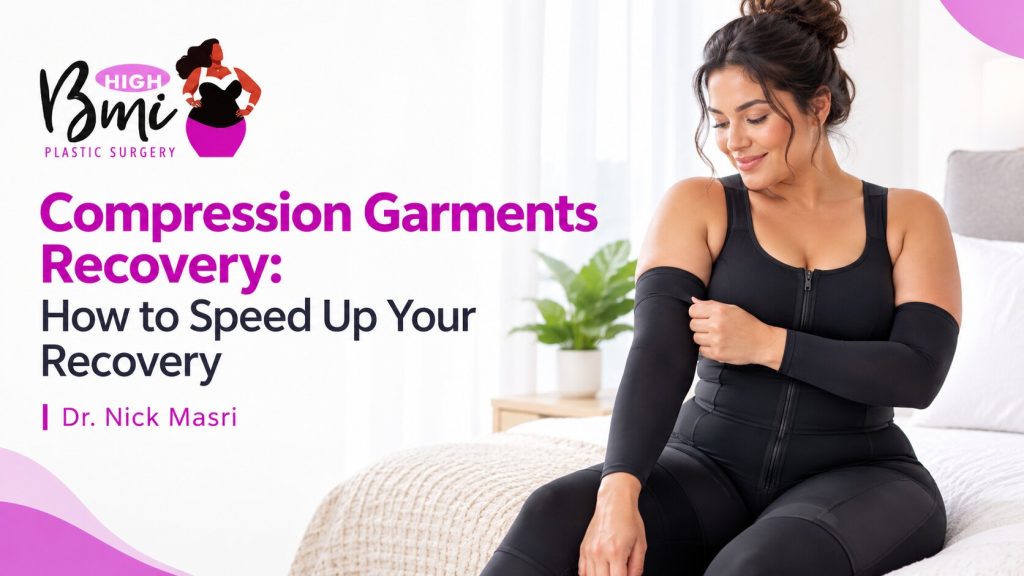
Almost every patient asks me some version of the same question in the days before surgery: “How long am I actually going to be stuck in this thing?”
It’s a fair question. Nobody enjoys wearing a tight garment for weeks at a time. But before I answer it, I want patients to understand why I’m asking them to wear one in the first place. Compression garments recovery isn’t about tradition, and it isn’t about making you smaller. It’s about giving your body the best possible environment to heal after tummy tuck, liposuction, a BBL, or a mommy makeover, whatever procedure brought you into my office.
I see this misunderstanding constantly. Patients believe the garment is doing the sculpting. It isn’t. The shape you end up with was created in the operating room, through the tissue that was removed, the muscle that was repaired, and the contour I designed for your anatomy specifically. The garment’s job starts after that work is already done.
What Compression Garments Actually Do During Recovery
After any body contouring procedure, whether it’s an abdominoplasty or liposuction, your body enters the inflammatory phase of wound healing almost immediately. Small blood vessels become more permeable, allowing fluid and immune cells to reach the surgical area. That process is necessary for healing, but it’s also what causes the swelling patients notice in the first days and weeks.1
A properly fitted compression garment applies gentle, even pressure that helps:
- Support tissue that was repositioned or elevated during surgery
- Reduce the space where fluid can accumulate
- Limit unnecessary movement of the treated area
- Improve comfort during walking, sitting, and standing
- Help skin redrape more evenly over the new contour
None of that changes your final result. What it does is protect the result while your body does the actual work of healing.
The Science Behind Compression Garments Recovery: What the Research Actually Shows
I want to be honest with patients about this, because a lot of what gets said online overstates the evidence. A 2023 practical review in Plastic and Reconstructive Surgery Global Open looked closely at postoperative compression across aesthetic procedures and found the evidence is genuinely mixed.2 Compression garments are reasonably well supported for reducing edema and bruising after certain procedures, and for improving comfort after breast and abdominal surgery. But for some outcomes patients assume are guaranteed, like preventing seroma formation, the data is far less conclusive than the garment industry would have you believe.
I don’t share that to talk patients out of wearing their garment. I share it because I think honesty builds trust, and because understanding what compression can and can’t do helps patients set realistic expectations. Compression is one supportive tool in a much larger recovery plan. It isn’t a substitute for surgical technique, and it isn’t a guarantee against every complication.
Compression Garments Recovery Looks Different Depending on the Procedure
This is something patients don’t always expect. The garment I recommend after a tummy tuck is not the same garment I recommend after liposuction, and both are different from what I recommend after a BBL or a mommy makeover combining several procedures.
After an abdominoplasty, the garment needs to support the repaired abdominal wall and the full length of the incision. I go into much more detail on this in our complete guide to compression garments after tummy tuck.
After liposuction, the garment is doing a slightly different job, helping the skin adhere evenly to the newly contoured tissue across a treated area that may include the abdomen, flanks, thighs, or arms. You can read more in our guide to compression garments after liposuction.
After a BBL, compression has to be applied carefully so it doesn’t put pressure directly on the transferred fat, which can affect graft survival.
After combined procedures, like a mommy makeover, the garment plan has to account for multiple treated areas healing at the same time.
There’s no single garment that works for every patient or every operation. This is one of the reasons I don’t hand every patient the same instructions and send them home.
What Compression Garments Recovery Cannot Do
I think it’s just as important to be clear about the limits. A compression garment will not:
- Remove fat
- Tighten loose skin
- Create muscle definition
- Replace the surgical work itself
- Fix a poorly healing incision
Those results come from surgical planning and technique. The garment protects that work while your tissue recovers; it doesn’t create it. Patients who understand this distinction tend to have a much healthier relationship with their recovery, because they aren’t watching the garment for changes it was never designed to produce.
Getting the Fit Right Actually Matters
One of the most common mistakes I see isn’t skipping the garment. It’s wearing the wrong one, or wearing the right one incorrectly.
Too tight creates its own set of problems:
- Restricted circulation
- Increased pain
- Pressure points and skin indentation
- Irritation along the incision
- Patients quietly avoiding wearing it consistently because it’s uncomfortable
Too loose simply fails to do its job. Without adequate support, treated tissue moves more during daily activity, and many of the intended benefits of compression are lost.
A garment should feel supportive, not restrictive. You should be able to breathe comfortably, walk normally, and sit without significant discomfort. If it’s creating pain rather than support, something needs to be adjusted, and that’s a conversation to have with your surgical team, not something to push through.
Signs Your Garment Fits Properly
- Even, consistent pressure across the treated area
- Comfortable breathing and normal movement
- No rolling, bunching, or shifting throughout the day
- A feeling of support rather than restriction
Warning Signs Your Garment May Be Too Tight
Contact your surgical team if you notice:
- Increasing pain rather than gradual improvement
- Numbness or persistent tingling
- Difficulty taking a full breath
- Skin irritation, breakdown, or deep indentations that don’t fade
- New swelling above or below the edges of the garment
- Appearance of skin blistering
Patients sometimes assume these symptoms mean the garment is “working hard.” In my experience, they almost always mean the opposite, that the compression is too aggressive for what the tissue can currently tolerate.
How Long Should Compression Be Part of Your Recovery?
There isn’t one universal timeline, and I’m always cautious about patients who go looking online for one. Compression garments recovery duration depends on several factors:
- The procedure or combination of procedures performed
- Whether muscle repair was involved
- The extent of tissue treated
- How your individual swelling responds over time
- Your tissue quality and overall healing pace
Most patients wear their garment continuously during the early weeks, when swelling is at its highest, then transition to part-time wear as their surgeon determines their tissue is ready.3 I don’t set that transition by counting days on a calendar. I set it by what I see at your follow-up visits. Some patients are ready to reduce compression sooner. Others benefit from a longer period of support. Both are normal.
Compression in High-BMI and Post-Weight-Loss Recovery
For patients with a higher BMI, or patients who have lost significant weight before surgery, compression often plays a slightly larger role in the overall recovery plan. There’s simply more treated surface area in many cases, longer incisions, and more tissue that needs even support while swelling gradually resolves.
That doesn’t mean more compression is automatically better; the same rules about proper fit still apply. It means the garment selection and the recovery plan need to be built around your specific anatomy rather than a generic size chart. This is part of why I perform higher-BMI body contouring in accredited hospital settings, so that every part of the recovery plan, compression included, is tailored rather than assumed.
My Approach to Compression Garments Recovery
I don’t give every patient the same instructions, because no two operations are identical. When I’m deciding on a compression plan, I’m thinking about:
- The extent of tissue elevation or fat removal
- Whether muscle repair was performed
- Your skin quality and elasticity
- The number of procedures performed together
- How your swelling responds at each follow-up
My goal isn’t to keep you in a garment for an arbitrary number of weeks. My goal is to support your tissue for exactly as long as it needs support, and not longer than that. Recovery should follow your body, not a printed handout.
Curious what results are realistically possible for your anatomy? You can browse our before-and-after photo gallery to see real outcomes from patients who went through this same process.
Recovery Isn’t Just About the Garment
Patients naturally focus on the garment because it’s the part of recovery they interact with every single day. But compression garments recovery is only one piece of a much larger plan. Your long-term outcome also depends on:
- The surgical technique used and how the tissue was handled
- Whether you maintain a stable weight after surgery
- Your nutrition, hydration, and protein intake during healing
- Not smoking, which significantly affects circulation and wound healing
- Attending your follow-up visits so your recovery plan can be adjusted as needed
No garment can compensate for skipping those fundamentals. I tell patients this not to add pressure, but because I want their focus spread across the things that actually determine how their recovery goes, not narrowed onto a single piece of medical fabric.
The Bottom Line
Compression garments recovery is a real, supportive part of healing after body contouring surgery, but it’s one piece of a much larger picture. The garment doesn’t create your result. It protects the result that was created in surgery while your tissue does the slow, steady work of healing underneath.
When compression is properly fitted, worn for the right duration, and paired with realistic expectations, it can make early recovery more comfortable and help swelling resolve more predictably. What it can’t do is replace good surgical planning, a stable weight, or patience with a process that genuinely takes months, not weeks.
Understanding that distinction is, in my experience, what separates patients who feel confident during recovery from patients who spend it anxious over a garment that was never meant to do more than support them.
Frequently Asked Questions
Does wearing a tighter compression garment speed up recovery?
No. Excessive compression doesn’t accelerate healing and may actually slow it down by restricting circulation to tissue that needs steady blood flow to recover. A properly fitted garment should feel supportive and even, not painfully tight.
Is compression equally important after every procedure?
Compression plays a role after most body contouring procedures, but the type of garment, the areas covered, and the duration all vary depending on what was done. A garment designed for tummy tuck recovery isn’t interchangeable with one designed for liposuction or BBL recovery.
Can I stop wearing my garment once the swelling looks better?
Not necessarily. Visible swelling often improves faster than the deeper healing process finishes. Your surgeon should guide when to reduce compression based on your tissue’s actual healing progress at follow-up visits, not on how flat your abdomen looks on a given day. Garment use is also adjusted to your level of activity. As you return to walking, work, and eventually exercise, I may have you wear it during your more active hours, when swelling tends to build, and ease off during rest, rather than following one fixed schedule for everyone.
References (AMA Style)
- Janis JE, Harrison B. Wound healing: Part I. Basic science. Plast Reconstr Surg. 2016;138(3 Suppl):9S-17S. doi:10.1097/PRS.0000000000002680. https://journals.lww.com/plasreconsurg/fulltext/2016/09001/wound_healing__part_i__basic_science.3.aspx
- Ormseth BH, Livermore NR, Schoenbrunner AR, Janis JE. The Use of Postoperative Compression Garments in Plastic Surgery—Necessary or Not? A Practical Review. Plast Reconstr Surg Glob Open. 2023;11(9):e5293. doi:10.1097/GOX.0000000000005293. https://pmc.ncbi.nlm.nih.gov/articles/PMC10519563/
- Janis JE, Harrison B. Wound healing: Part II. Clinical applications. Plast Reconstr Surg. 2016;138(3 Suppl):18S-28S. doi:10.1097/PRS.0000000000002681. https://journals.lww.com/plasreconsurg/fulltext/2016/09001/wound_healing__part_ii__clinical_applications.4.aspx