

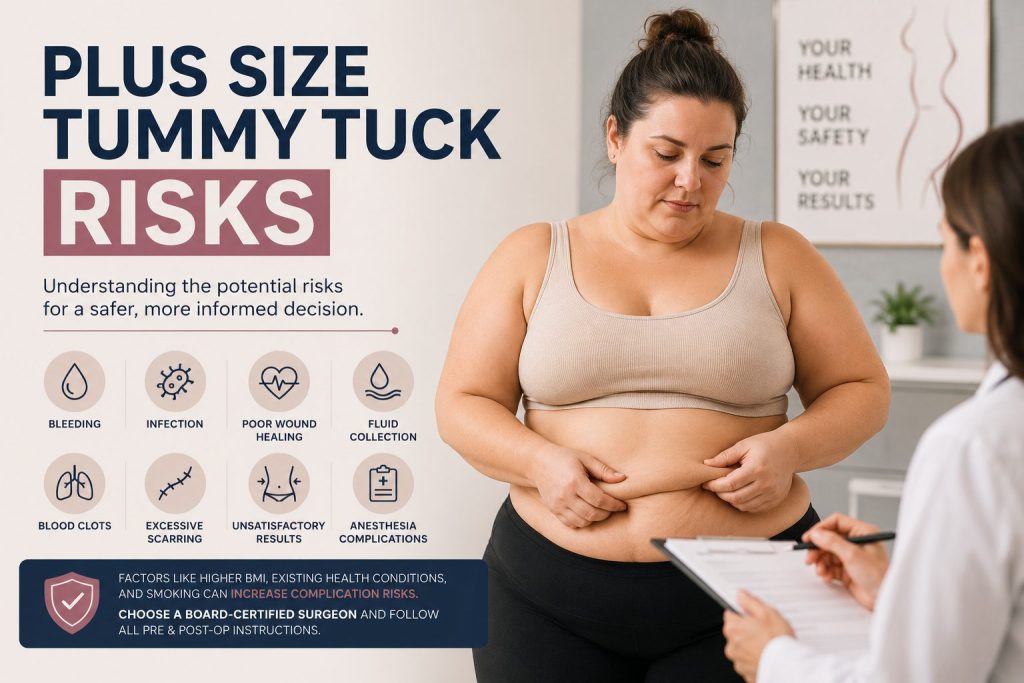
If you are carrying a higher BMI and researching plus size tummy tuck surgery, I want to talk to you directly — not with a list of disqualifying criteria, and not with vague reassurances either. What I want to give you is an honest picture of how I think about these cases, what the real considerations and plus size tummy tuck risks are, and why thoughtful surgical planning changes outcomes significantly.
Higher BMI does not automatically mean surgery is not possible. It means the conversation needs to go deeper. I have performed these procedures on plus size patients, and what I have learned shapes how I approach every single one.
Why Higher BMI Increases Certain Surgical Risks for a Plus Size Tummy Tuck
Patients searching for “BMI limit for tummy tuck” or “body mass index requirements for abdominoplasty” deserve honest conversations about the plus size tummy tuck risks associated with elevated BMI.
Delayed Wound Healing
Patients with a higher BMI may also have slower healing times due to increased tension at the suture line of thicker tissue layers. Additionally, decreased blood flow may affect tissue healing.1
Before surgery, moisture and friction around the groin junction from the lower abdominal fold can also affect the condition of the skin and reliability of the closure. Before I ever think about incision placement, I look at the skin in the lower abdominal fold and groin crease. This area lives under constant moisture and friction, and in many plus size patients, there is already some degree of chronic irritation or breakdown happening there — sometimes without the patient even realizing how significant it is.
Scar Tension and Skin Separation
Stress on the incision may be higher during recovery, especially on the lower central abdomen, where tension is greatest due to excess downward pull from heavier abdominal tissue.2
The way I manage this is through layered closure. Rather than relying on the skin surface to hold everything together, I place multiple layers of sutures through the deeper tissues, distributing tension across those layers rather than concentrating it at the skin. This protects the incision during the weeks when healing tissue is still fragile. It also creates a better foundation for the scar itself — one that sits flat, heals predictably, and ends up in the right position. The goal is always a scar that is as discreet as possible, given the anatomy we are working with.
Fluid Collections (Seromas)
Seromas occur when fluid accumulates beneath the skin after surgery. Larger dissection areas and thicker abdominal tissue may increase this risk after abdominoplasty.2
Drains are placed during surgery specifically to prevent this; they give fluid somewhere to go rather than pooling under the skin. I teach every patient how to monitor and empty their drains at home and how to track daily output, because changes in that output tell us something important.
At the first postoperative visit, I assess drain function and timing of removal carefully. If a seroma develops after drains come out, it is typically managed with aspiration in the office — a straightforward procedure. What I ask of patients is simple: if you notice sudden fullness or a soft bulge developing beneath the incision, call us. Don’t wait to see if it resolves on its own.
Infection Risk
Patients with elevated BMI may face higher rates of postoperative infection due to increased tissue stress, moisture retention within skin folds, and delayed healing.1
Antibiotic prophylaxis is administered intravenously before and during the procedure — not afterward when the problem has already started. I walk every patient through exactly how to keep the incision area clean and dry. The compression garment plays a role here too; it is not just for swelling. Any sign of warmth, increasing redness, or discharge at the incision line is something I want to hear about immediately. Early intervention on infection is straightforward. Waiting is not.
Anesthesia Considerations
Higher BMI can affect airway management, breathing mechanics, positioning requirements, and cardiovascular strain during anesthesia. This is one reason I perform these procedures in accredited hospitals with experienced anesthesia teams familiar with higher-BMI surgery.2
Before surgery, the anesthesia team reviews your complete medical history independently. Airway planning, positioning strategy, and cardiovascular monitoring are all mapped out before you enter the operating room. I also want patients to understand the difference between sedation and general anesthesia, because there is often confusion. Sedation keeps you relaxed while you remain partially aware. General anesthesia induces full unconsciousness — you are completely unaware throughout. For a plus size tummy tuck, general anesthesia is standard. A breathing tube is placed to protect your airway for the duration of the procedure. None of this happens without deliberate planning between the anesthesia team and me in advance.
Elevated Risk of Blood Clots
There is an association between obesity and venous thromboembolism (VTE) — such as deep vein thrombosis and pulmonary embolism — especially with more prolonged procedures.2
In my practice, DVT and PE prevention is a structured protocol, not an afterthought. Sequential Compression Devices — pneumatic compression socks — go on the patient’s legs before the procedure begins and stay on throughout surgery and the hospital stay. Blood-thinning medications are prescribed postoperatively when appropriate.1 And from the evening of surgery, my nursing team is getting patients up and walking. Not because it is comfortable — it isn’t, not at first — but because early movement is one of the most powerful tools we have for keeping circulation moving and clots from forming.
Conclusion
What I want you to take away from this is simple. A higher BMI means we need to plan more carefully, not that we close the door. The patients I see who do well are not necessarily the ones with the lowest plus size tummy tuck risk profiles. They are the ones who came in informed, asked honest questions, and worked with me through the preparation process.
Skin condition, circulation, closure tension, clot prevention — these are not afterthoughts in my practice. They are the foundation. If you are considering a plus size tummy tuck surgery, come in and let us have a real conversation, or read our complete Plus Size Tummy Tuck guide, which explains candidacy, preparation, recovery, and what to expect before moving forward.
References (AMA Style)
- Pannucci CJ, Dreszer G, Fisher Wachtman C, et al. Postoperative enoxaparin prevents symptomatic venous thromboembolism in high-risk plastic surgery patients. Plast Reconstr Surg. 2011;128(5):1093–1103. doi:10.1097/PRS.0b013e31822b6817. https://pubmed.ncbi.nlm.nih.gov/22030491/
- Shermak MA, Chang D, Magnuson TH, Schweitzer MA. An outcomes analysis of patients undergoing body contouring surgery after massive weight loss. Plast Reconstr Surg. 2006;118(4):1026–1031. doi:10.1097/01.prs.0000232393.74913.70. https://pubmed.ncbi.nlm.nih.gov/16980866/